
The document introduces the various types and characteristics of photoelectric sensors
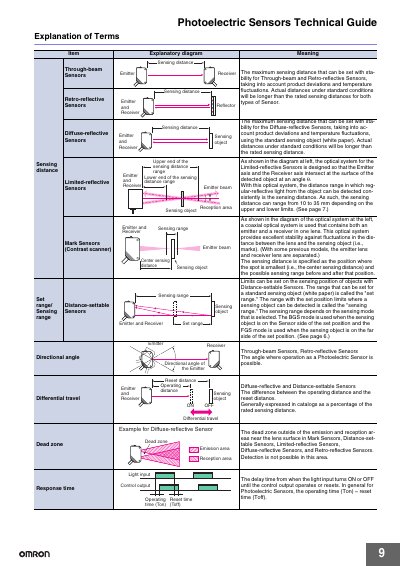
This document explains the technical specifications and operational principles of Mitsubishi Electric’s photoelectric sensors, including through-beam, retro-reflective, diffuse-reflective, and limited-reflective types. It details sensing distance, directional angle, response time, and detection methods for various sensor configurations. The guide also covers the MSR (Mirror Surface Rejection) function for detecting glossy surfaces and provides application examples for height differences and object detection.
The document includes diagrams and specifications for standard sensing objects, such as white paper and reflectors, and explains how to adjust sensitivity for optimal detection. It also addresses detection challenges with glossy surfaces and provides recommendations for sensor installation to ensure stable operation.
| Sensing Distance | Maximum distance set with stability, adjusted for product deviations and temperature fluctuations. |
|---|---|
| Standard Sensing Object | White paper for diffuse-reflective sensors; opaque rod for through-beam and retro-reflective sensors. |
| Response Time | Operating time (Ton) equals reset time (Toff). |
| MSR Function | Uses polarizing filters to reject light from glossy surfaces. |
The MSR function uses polarizing filters to reject light from glossy surfaces, enabling stable detection of objects with mirror-like surfaces.
The standard sensing object for diffuse-reflective sensors is a sheet of white paper larger than the diameter of the emitted beam.
The sensing distance for limited-reflective sensors is the range where regular-reflective light from the object can be detected consistently, ranging from 10 to 35 mm depending on the upper and lower limits.