
This document describes the features and characteristics of the Rosemount ™ TCL Total Chlorine System with Rosemount 1056 Transmitter
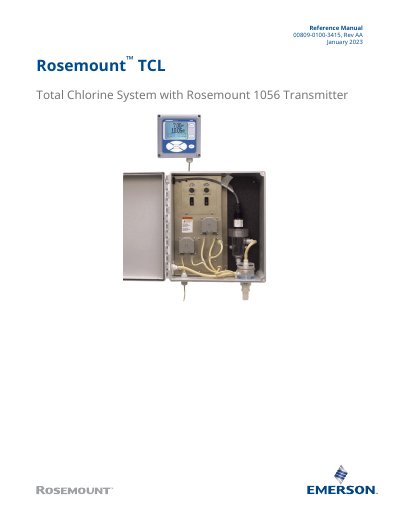
The Rosemount TCL Total Chlorine System is designed to measure total chlorine in water using a single sensor within a sample conditioning system. The system continuously injects a reagent of acetic acid and potassium iodide to lower the sample pH, allowing total chlorine to react and produce iodine, which is then measured by the sensor. The Rosemount 1056 Transmitter houses the electronics in a corrosion-resistant NEMA 4X enclosure and features a membrane keypad for operation and programming.
| Enclosure Rating | NEMA 4X |
|---|---|
| Power Source | Grounded three-wire power source |
| Max External Power | 69 Vdc or 43 V peak |
| Relay Count | Four fully programmable relays |
| Sensor Type | Rosemount 499ACL-02 Total Chlorine Sensor |
| Temperature Sensor | Pt100 RTD |
The system continuously injects a solution of acetic acid and potassium iodide into the sample.
Although called a chlorine sensor, it measures iodine produced by the reaction between oxidants and the reagent.
The transmitter uses the temperature measured by a Pt100 RTD in the sensor to compensate for changes in membrane permeability.