
introduces the flow measurement instrument annubar flow principle and measurement principle
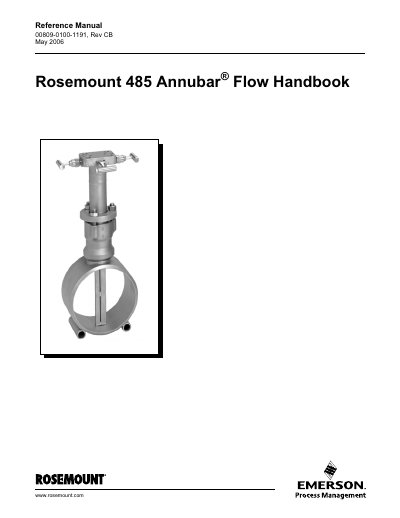
This handbook serves as a comprehensive reference for accurately measuring fluid flow using the Rosemount 485 Annubar primary element. It details the physical fluid properties required for flow calculations, including pressure, temperature, density, and viscosity, explaining the relationship between absolute and gauge pressures and the importance of using absolute units for gases.
The document further develops flow equations based on Bernoulli's Theorem, specifically modified for the 485 Annubar sensor. It covers flow coefficient theory, Reynolds number dependency, and provides examples for calculating actual and standard volumetric flowrates for both liquids and gases. Additionally, it addresses potential installation and operational errors such as alignment issues, upstream flow disturbances, and dirt accumulation.
The standard atmospheric pressure used is 14.696 psia (101.325 kPa).
Water at either 60 °F (15°C) or 77 °F (25°C) is used as the reference substance.