
This document is a user manual for the CD34 capacitive sensor, which contains important information regarding installation, settings, and connections. It is recommended to read the manual carefully before installing the sensor and save it for future use. The sensor is designed for water-based liquid (conductive) level detection and its functions are guaranteed when installed according to the guidelines in this manual and using the specified installation accessories. This manual applies to all models of the CD34 sensor family. Additionally, the manual includes safety precautions and product description and applications.
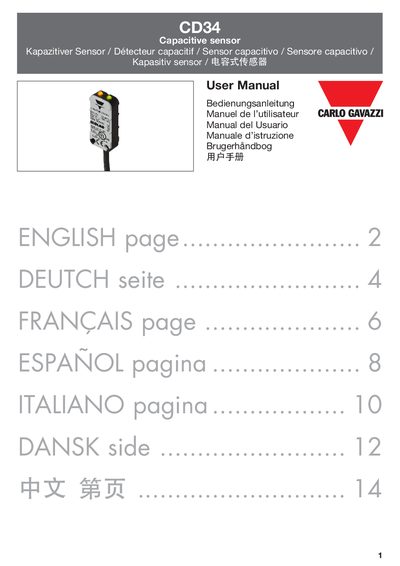
The Carlo Gavazzi CD34 capacitive sensor is designed for detecting water-based (conductive) liquids through non-metallic container walls, such as plastic or glass. It automatically adapts to various wall thicknesses and compensates for residue, moisture, or foam. The sensor is suitable for applications involving liquids with conductivity up to 50 mS/cm, including water, milk, and body fluids.
| Application | Water-based liquid (conductive) level detection |
|---|---|
| Conductivity Range | Up to 50 mS/cm |
| Wall Thickness (Plastic) | 0.5 to 6 mm |
| Wall Thickness (Glass) | 0.5 to 4 mm |
| LED Indicators | Green (Power ON), Yellow (Output) |
| Protection | Short circuit and reversed polarity |
| Approvals | CE, UL, ECOLAB |
The sensor detects water-based liquids such as water, milk, body fluids, and acid- or alkaline solutions.
Connect the teach wire to V+ for 2 to 7 seconds until the LEDs flash as described.
Connect the teach wire to V+ for 7 to 12 seconds until the LEDs flash as described.
No, the sensor cannot be repaired and must be disposed of according to waste electrical and electronic equipment directives.