
This document describes the features and characteristics of the Cell Cycle Detection Kit (containing RNase A). The kit uses propidium iodide as a fluorescent dye and can be used to measure DNA content of cells using flow cytometry, allowing analysis of cell cycle and cell apoptosis. The kit is suitable for cell cycle and cell apoptosis detection in adherent or suspension cells.
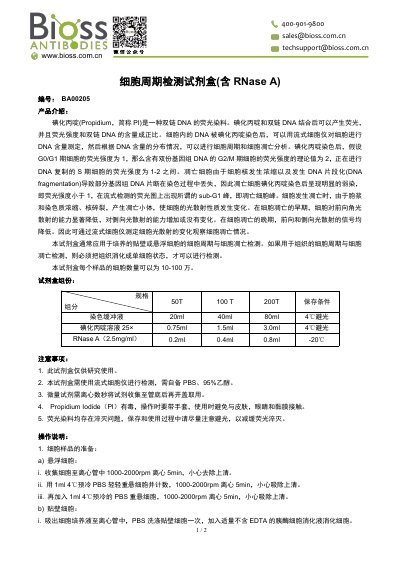
The Bioss BA00205 Cell Cycle Detection Kit contains Propidium Iodide (PI) and RNase A for detecting cell cycle distribution and apoptosis in cultured adherent or suspended cells. The kit allows for DNA content measurement via flow cytometry, where G0/G1 phase cells have a fluorescence intensity of 1, G2/M phase cells have an intensity of 2, and S phase cells range between 1 and 2. Apoptotic cells typically show a sub-G1 peak due to DNA fragmentation and loss during staining.
The document provides detailed instructions for sample preparation, including protocols for both suspended and adherent cells, cell fixation with 95% ethanol, and the preparation of the PI staining solution. It specifies that the kit is suitable for 100,000 to 1,000,000 cells per sample and requires a flow cytometer for analysis at an excitation wavelength of 488nm. This manual is written in Chinese.
| Sample Cell Count | 10-1000000 cells per sample |
|---|---|
| Excitation Wavelength | 488nm |
| RNase A Concentration | 2.5mg/ml |
| PI Staining Time | 30 minutes at 37°C |
The kit is suitable for 100,000 to 1,000,000 cells per sample.
It is typically applied to cultured adherent or suspended cells, though tissue samples must be digested into single cells first.
Analysis should be performed at an excitation wavelength of 488nm.