
This document describes the features and characteristics of O.C.T. Compound, including its tissue support function, water solubility, and its applications in clinical rapid pathological staining diagnosis, immunohistochemistry, and in situ hybridization.
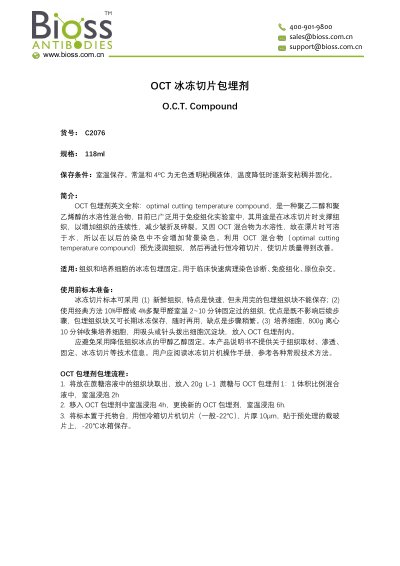
The BIOSS C2076 OCT Compound is a water-soluble mixture of polyethylene glycol and polyvinyl alcohol. It is designed to support tissue during frozen sectioning, increasing continuity and reducing folding and fragmentation. Because it is water-soluble, it dissolves during washing steps, preventing increased background staining in subsequent procedures. The product is supplied as a colorless, transparent viscous liquid at room temperature and 4°C, which gradually solidifies as the temperature decreases. This manual is written in Chinese.
| Volume | 118ml |
|---|---|
| Storage Condition | Room temperature |
| Appearance | Colorless transparent viscous liquid |
| Components | Polyethylene glycol and polyvinyl alcohol |
It is used to support tissue during frozen sectioning to increase continuity and reduce folding and fragmentation.
Tissue blocks can be taken from sucrose solution and soaked in a 1:1 volume mixture of 20g L-1 sucrose and OCT compound at room temperature for 2 hours.
Fragile sections are caused by freezing too quickly or if the specimen is too large.