
This application note describes how to control a brush DC motor with the ST6265 microcontroller. This method does not require a speed sensor, which makes it more efficient and reduces acoustic noise.
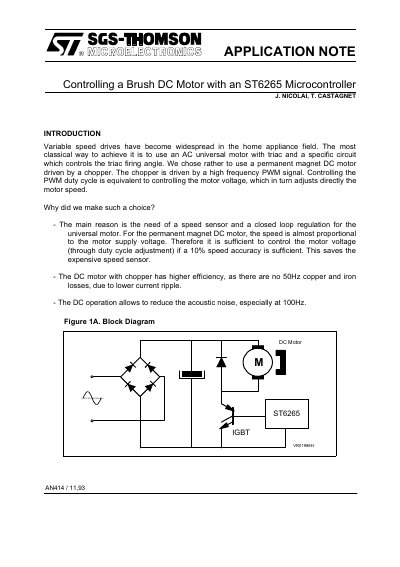
The document details a variable speed drive design for home appliances that uses a permanent magnet DC motor driven by a chopper. This approach eliminates the need for expensive speed sensors required in AC universal motor drives, offering higher efficiency and lower acoustic noise.
The ST6265 microcontroller is central to this design, generating high-frequency PWM signals to control the IGBT chopper switch. The MCU also handles voltage compensation by measuring mains voltage via its internal A/D converter to stabilize motor speed against supply fluctuations, and implements software-based power limitation.
The application features a 300 watts maximum power limit.
The process must occur at least every milli-second to get a large ripple reduction.