
Initializing DSP System and Control Registers from C and C++ Application Note

Initializing DSP System & Control Registers From C and C++
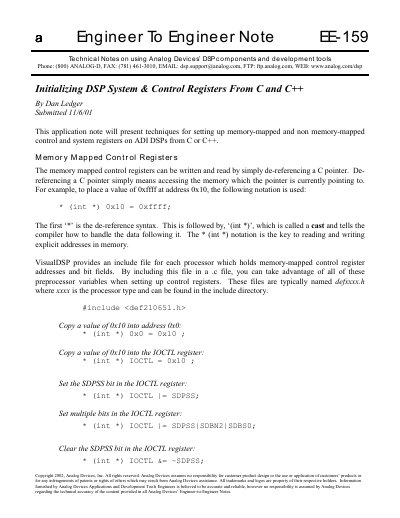

Initializing DSP System and Control Registers from C and C++ Application Note - cover page
Brand
Analog Devices
Category
microcontrollers
Document type
Application Note
Language
English
Pages
2
File format
PDF
File size
15 KB
Published
03 August, 2012
Updated
01 October, 2023
MD5 checksum
ABCA917B801C92B8BD94572801321222

About this manual

The document provides methods for initializing system registers in C code. For memory-mapped control registers, it describes dereferencing C pointers to access specific addresses, utilizing include files like defxxxx.h that define register addresses and bit fields.

For non-memory-mapped control registers (such as the MODE2 or IMASK registers), the note details the use of inline assembly and macros provided in sysreg.h. It lists functions for reading, writing, setting, clearing, toggling, and testing bits within these registers.

What's inside

  • Memory Mapped Control Registers
  • Dereferencing C Pointers
  • Include Files (defxxxx.h)
  • Non-Memory Mapped Control Registers
  • Inline Assembly
  • sysreg Functions

Frequently asked questions

How do you write a value to a memory-mapped control register in C?

You dereference a C pointer pointing to the address, for example: * (int *) OxlO = Oxffff;

What functions are available in sysreg.h for non-memory-mapped registers?

The include file provides prototypes such as sysreg_read, sysreg_write, and sysreg_bit_clr.

Download PDF (15 KB)

More Analog Devices Manuals


View all Analog Devices manuals →