
This document provides information on using Analog Devices' DSP, audio, and video components. It covers the use of ADSP-218x I/O space and discusses the design considerations for I/O in a DSP system.
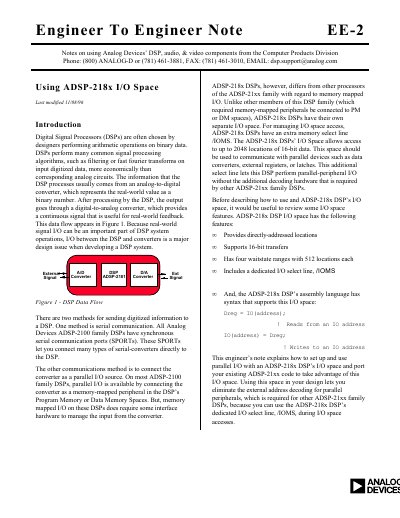
Analog Devices' ADSP-218x Digital Signal Processors feature a unique, separate I/O space that allows direct access to up to 2048 locations of 16-bit data. This dedicated space supports parallel-peripheral I/O without the need for external address decoding hardware required by other members of the ADSP-21xx family.
The document provides instructions on setting up and using this I/O space, including how to modify system files and architecture definitions when porting existing code from ADSP-2101 or similar processors. It also details how to access I/O ports using inline assembly within C programs and describes features for simulating I/O operations.
| Data width | 16-bit data |
|---|---|
| I/O space size | up to 2048 locations |
It allows parallel-peripheral I/O without additional decoding hardware.
Use the syntax Dreg = IO(address) to read and IO(address) = Dreg to write.