
ANALOG DEVICES Considerations for Selecting a DSP Processor ADSP-21161 vs TMS360C6711/12 Manual

This is an application note that introduces two floating point digital signal processors: the ADSP-21161 and TMS320C6711/TMS320C6712.
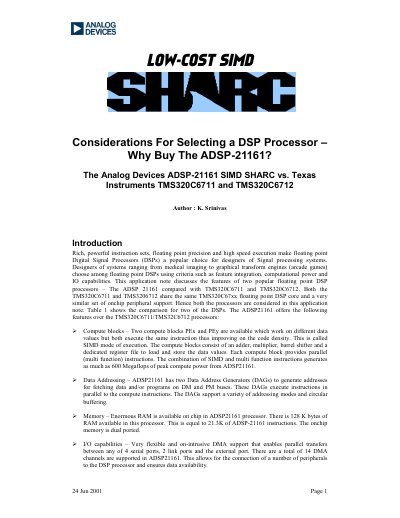

ANALOG DEVICES Considerations for Selecting a DSP Processor ADSP-21161 vs TMS360C6711/12 Manual - cover page
Brand
Analog Devices
Document type
Application Note
Language
English
Pages
27
File format
PDF
File size
401 KB
Published
03 August, 2012
Updated
30 September, 2023
MD5 checksum
930EC2DD4028BE8607CCFC4949536684

About this manual

This document serves as a technical comparison between the Analog Devices ADSP-21161 SIMD SHARC DSP and Texas Instruments' TMS320C6711/C6712 floating-point DSPs. It evaluates both processors across computational core features, I/O capabilities, memory architecture, and programmability to assist designers in selecting the appropriate chip for signal processing systems.

What's inside

  • Introduction
  • Compute Blocks (SIMD)
  • Data Addressing
  • Memory Architecture
  • I/O Capabilities
  • Comparison Table
  • Programmability

Frequently asked questions

What is the maximum peak compute power of the ADSP-21161?

The processor generates as much as 600 Megaflops of peak compute power.

How many DMA channels are supported by the ADSP-21161?

The processor supports a total of 14 DMA channels.

What is the size of the on-chip RAM available in the ADSP-21161?

There are 128 K bytes of RAM available in this processor.

Download PDF (401 KB)

More Analog Devices Manuals


View all Analog Devices manuals →