
Analog Devices EE-126 The ABCs of SDRAM Memories Application Note

This document provides technical notes on using Analog Devices' DSP components and development tools. It specifically discusses the features of ADSP-21065L, ADSP-21161N, and ADSP-TS101S from the floating-point family of DSPs, including their on-chip SDRAM interface for cost-effective designs.
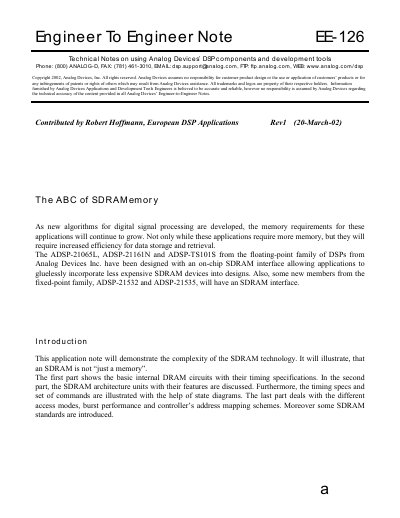

Analog Devices EE-126 The ABCs of SDRAM Memories Application Note - cover page
Brand
Analog Devices
Category
Memory
Document type
Application Note
Language
English
Pages
36
File format
PDF
File size
186 KB
Published
03 August, 2012
Updated
29 September, 2023
MD5 checksum
7F0596958F514FC9C393C82AE193BC4C

About this manual

This application note, titled 'The ABCs of SDRAM Memories', provides a technical overview of Synchronous Dynamic Random Access Memory (SDRAM) technology. It is designed to demonstrate the complexity of SDRAM, illustrating that it is more than just a memory component. The document covers basic internal DRAM circuits, timing specifications, and refresh issues.

What's inside

  • DRAM Technology
  • SDRAM Architecture
  • Timing Issues
  • Memory Organization
  • Initialization and Power up
  • Commands
  • Command Coding
  • On Page Column Access
  • Off Page Column Access
  • SDRAM Controller

Frequently asked questions

What is the primary function of an SDRAM cell?

An SDRAM cell stores data in a capacitor that holds a logical value based on its charge state.

What is the typical capacitance range for an SDRAM storage cell?

Each storage cell consists of a very small capacitor ranging from about 20 to 40 femtofarads.

What happens to data stored in a DRAM cell if it is not refreshed?

The capacitors gradually lose their charge and the device will lose its data.

Download PDF (186 KB)

More Analog Devices Manuals


View all Analog Devices manuals →