
This document describes a design method for a six-legged robotic spider that uses graphical programming, high computing processing performance, and an ultralow energy scheme for optimal mobility in harsh environments.
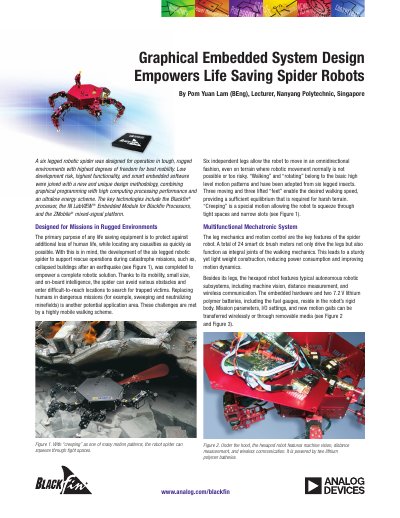
The document details the design of a six-legged robotic spider intended for operation in rugged environments, such as collapsed buildings or minefields. The robot features high mobility with omnidirectional movement and specialized 'creeping' capabilities to navigate tight spaces. It is equipped with autonomous subsystems including machine vision, distance measurement, and wireless communication.
The system relies on the Analog Devices Blackfin processor and the ZMobile mixed-signal platform supplied by Schmid Engineering. The software is developed using LabVIEW Embedded Module for Blackfin Processors, allowing for graphical programming and deterministic real-time behavior. Key technologies include 24 smart DC brush motors acting as integral joints and an ultralow energy scheme to extend operation time.
The robot is designed to support rescue operations in catastrophe missions, such as searching for trapped victims in collapsed buildings or neutralizing minefields.
A total of 24 smart brush motors drive the legs and function as integral joints of the walking mechanics.
The robot is powered by two 7.2 V lithium polymer batteries that include fuel gauges.
Trajectories can be programmed using teach-in and playback, 3D CAD software simulation, or continuously calculated inverse kinematics at runtime.