
AD5696/AD5694 is a quad 16/12-bit nanoDAC+ with I2C interface from Analog Devices. Its features include high relative accuracy (INL), tiny package, high drive capability, user-selectable gain, 1.8 V logic compatibility, 400 kHz I2C-compatible serial interface, low glitch, robust ESD rating, low power and wide temperature range.
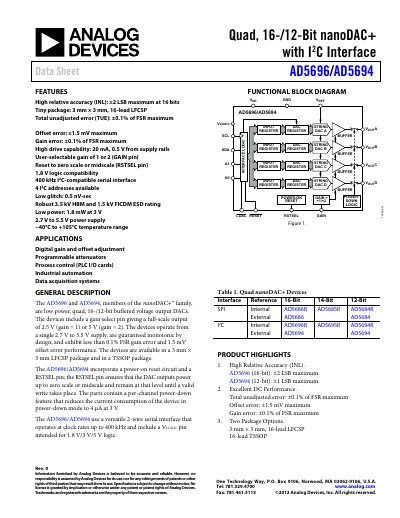
The AD5696 and AD5694 are low power, quad, 16-/12-bit buffered voltage output DACs from Analog Devices. These devices include a gain select pin providing full-scale outputs of either 2.5 V or 5 V, depending on the configuration. They operate from a single supply ranging from 2.7 V to 5.5 V and are guaranteed monotonic by design.
| Resolution (AD5696) | 16 Bits |
|---|---|
| Resolution (AD5694) | 12 Bits |
| Relative Accuracy (INL) AD5696 | +2 LSB maximum at Gain=2 |
| Total Unadjusted Error | +0.1% of FSR maximum |
| Offset Error | +1.5 mV maximum |
| Gain Error | +0.1% of FSR maximum |
| Power Supply Range | 2.7 V to 5.5 V |
| Temperature Range | -40°C to +105°C |
| Interface Speed | Up to 400 kHz |
The maximum relative accuracy (INL) for the AD5696 is +2 LSB.
The devices are available in a 3 mm x 3 mm LFCSP package and in a TSSOP package.
Yes, there is a user-selectable gain of either 1 or 2 via the GAIN pin.