
AD5110/AD5112/AD5114 are three 12-bit single-ended digital potentiometers from AD company, supporting I2C interface, working voltage range of 2.3V-5.5V, can be applied to sensor, potentiometer, voltmeter and other circuits.
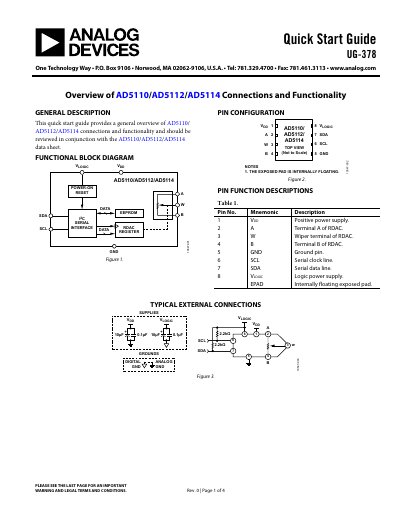
The document describes the AD5110/AD5112/AD5114 digital potentiometers, including the functional block diagram, pin configuration, pin function descriptions, and typical external connections. It covers operational conditions, I2C command set, shift register timing, and examples for calculating end-to-end resistance and writing/reading registers.
| VDD supply voltage | 2.3 V to 5.5 V |
|---|---|
| VLOGIC supply voltage | 1.8 V to VDD |
| Maximum continuous current (5 kΩ, 10 kΩ) | ±6 mA |
| Maximum continuous current (80 kΩ) | ±1.5 mA |
| Maximum I2C clock frequency | 400 kHz |
The VDD supply voltage ranges from 2.3 V to 5.5 V.
Read the resistor tolerance data from EEPROM, compute the tolerance percentage, and apply it to the nominal resistance; for example, a tolerance of -10.25% on a 10 kΩ resistor gives 8.975 kΩ.
The maximum SCL clock frequency is 400 kHz.