
The document introduces PGA309, a programmable analog signal conditioner designed for bridge sensors. It features voltage output, digital calibration, sensor error compensation, sensor linearization circuitry, etc.
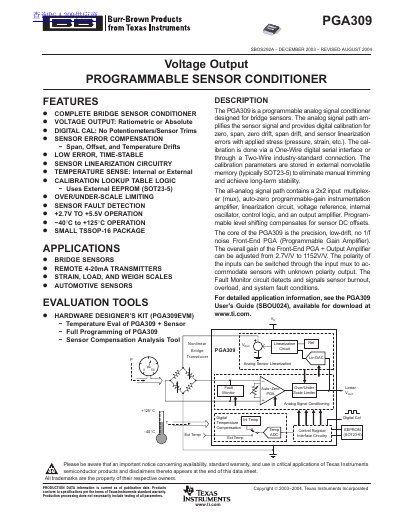
The PGA309 is a voltage output programmable sensor conditioner designed specifically for bridge sensors. It amplifies the sensor signal and provides comprehensive digital calibration for zero, span, drift, and linearization errors via a One-Wire or Two-Wire interface.
The device features an all-analog signal path including a 2x2 input multiplexer, auto-zero programmable-gain instrumentation amplifier, and linearization circuitry. Calibration parameters are stored in external nonvolatile memory to eliminate manual trimming. The core Front-End PGA offers adjustable gain from 2.7V/V to 1152V/V with low noise and drift characteristics.
| Supply Voltage Range | +2.7V to +5.5V |
|---|---|
| Operating Temperature Range | -40°C to +125°C |
| Package Type | TSSOP-16 |
| Front-End PGA Gain Range | 2.7V/V to 1152V/V |
| Output Voltage Range | Ratiometric or Absolute |
| Input Current Limit | +/- 150mA |
| Output Current Limit | 50mA |
It is designed for bridge sensors, remote 4-20mA transmitters, strain/load/weigh scales, and automotive sensors.
Calibration is done via a One-Wire digital serial interface or through a Two-Wire industry-standard connection.
No, it features digital calibration with no potentiometers or sensor trims required.