
Altera Stratix GX High-Speed Source-Synchronous Differential I/O Interfaces Application Note

Describes the high-speed source-synchronous differential I/O interfaces in Altera Stratix GX devices, introduces the DPA feature, and compares DPA with CDR
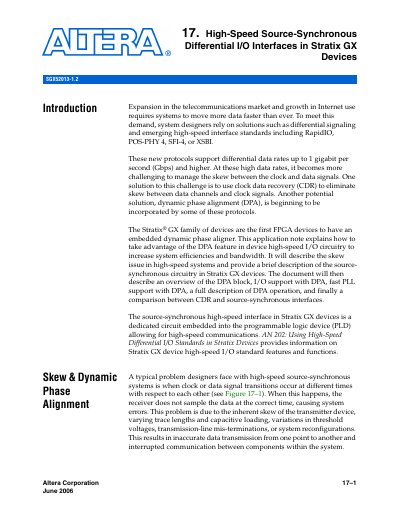

Altera Stratix GX High-Speed Source-Synchronous Differential I/O Interfaces Application Note - cover page
Brand
Altera
Category
Other Electronics
Document type
Application Note
Language
English
Pages
28
File format
PDF
File size
487 KB
Published
01 August, 2012
Updated
30 September, 2023
MD5 checksum
19DE75ED04ACE13DF4ACEF0AC7C1C4EF

About this manual

The document addresses the challenge of managing skew between clock and data signals in high-speed telecommunications systems. It introduces Dynamic Phase Alignment (DPA), a feature embedded in the Stratix GX family of FPGAs, which eliminates this skew to increase system efficiencies and bandwidth without requiring fixed training patterns or higher power consumption associated with individual analog PLLs.

What's inside

  • Introduction
  • Skew & Dynamic Phase Alignment
  • Stratix GX I/O Banks
  • Dedicated Source-Synchronous Circuitry
  • DPA Block Overview
  • Interface & Fast PLL

Frequently asked questions

What is the maximum data rate supported by DPA?

The dynamic phase aligner supports differential I/O standards at speeds up to 1 Gbps with DPA.

Does the Stratix GX DPA require a fixed training pattern?

No, unlike previous devices, you do not have to use a fixed training pattern with DPA in Stratix GX devices.

Which I/O standards are supported by the dynamic phase aligner?

The dynamic phase aligner supports LVDS, LVPECL, and 3.3-V PCML I/O standards.

Download PDF (487 KB)

More Altera Manuals


View all Altera manuals →