
This manual introduces the capabilities and specifications of the Lowrance X102C and X107CDF fish finders and depth sounders. It also explains how sonar works and provides instructions on installation and operation.
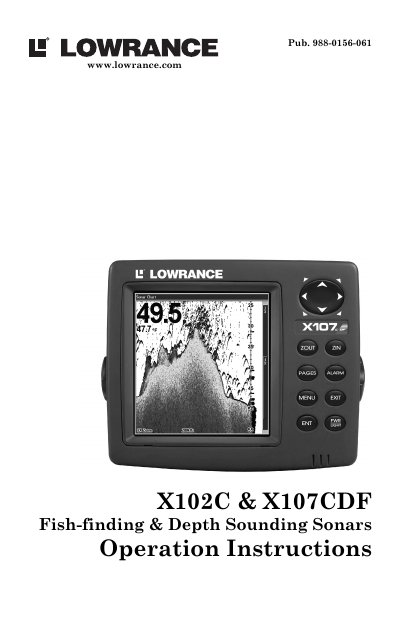
This manual provides comprehensive operating instructions for the Lowrance X102C and X107CDF digital sonar units. It guides users through initial setup, including transducer installation (shoot-thru-hull or transom mount) and power connections. The guide explains how to use the unit's keypad and menu system to access various sonar pages.
| Display Resolution | 480 pixel x 480 pixel resolution ; 230,400 total pixels. |
|---|---|
| Input Power | 10 to 15 volts DC. |
| Case Size (X102C/X107CDF) | 5.4" H x 6.9" W x 3.4" D |
| Sonar Frequency (X107CDF) | 50/200 kHz |
| Sonar Sounding Depth (X107CDF) | 2,500 feet (762 meters). |
| Transmitter Power (X102C) | 2,400 watts peak-to-peak/300 watts RMS. |
The storage temperature range is from -4 degrees to +167 degrees Fahrenheit (-20 degrees to +75 degrees Celsius).
Yes, a dual-frequency Skimmer transducer with built-in temperature sensor is packed with the X107CDF.