
This manual describes the features and specifications of the Lowrance X125, X126DF, X135, X136DF fish finders, as well as instructions for installation and use.
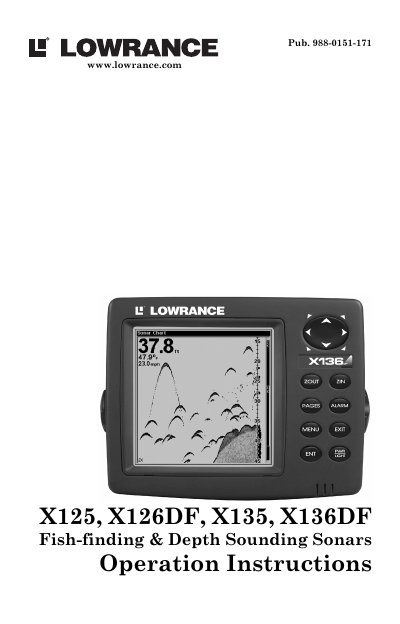
This manual provides operation instructions for the Lowrance X125, X126DF, X135, and X136DF fish-finding and depth sounding sonars. It covers the basics of how sonar works, installation preparations, and transducer mounting options including shoot-thru-hull and transom mounting. The guide details keyboard usage, menu navigation, and basic sonar operations such as viewing fish symbols and full sonar charts. It also explains advanced features like ASP (Advanced Signal Processing), various alarms, and display customization options including brightness, contrast, and zoom functions.
| Display Resolution | 480 pixel x 480 pixel |
|---|---|
| Input Power | 10 to 15 volts DC |
| Case Size | 5.4" H x 6.9" W x 3.4" D |
| Sonar Frequency (X126DF/X136DF) | 50/200 kHz |
| Sonar Frequency (X125/X135) | 200 kHz |
| Transmitter Power (X136DF/X135/X126DF) | 4,000 watts peak-to-peak/500 watts RMS |
| Transmitter Power (X125) | 2,400 watts peak-to-peak/300 watts RMS |
| Sounding Depth (X136DF) | 2,500 feet (762 meters) |
| Sounding Depth (X126DF) | 1,700 feet (518 meters) |
| Sounding Depth (X135) | 1,000 feet (305 meters) |
| Sounding Depth (X125) | 800 feet (244 meters) |
The storage temperature range is from -4 degrees to +167 degrees Fahrenheit (-20 degrees to +75 degrees Celsius).
Yes, built-in memory stores sonar records for decades.
No, all screens in the manual are simulated.