
The MAX107 is a dual, 6-bit, analog-to-digital converter (ADC) designed to allow fast and precise digitizing of in-phase (I) and quadrature (Q) baseband signals. The MAX107 converts the analog signals of both I and Q components to digital outputs at 400Msps while achieving a signal-to-noise ratio (SNR) of typically 37dB with an input frequency of 125MHz, and an integral nonlinearity (INL) and differential nonlinearity (DNL) of ±0.25 LSB. The MAX107 analog input preamplifiers feature a 400MHz, -0.5dB, and a 1.5GHz, -3dB analog input bandwidth. Matching channel-to-channel performance is typically 0.04dB gain, 0.1LSB offset, and 0.2 degrees phase. Dynamic performance is 36.7dB signal-to-noise plus distortion (SINAD) with a 125MHz analog input signal and a sampling speed of 400MHz. A fully differential comparator design and encoding circuits reduce out-of-sequence errors, and ensure excellent metastable performance of only one error per 1016 clock cycles. In addition, the MAX107 provides LVDS digital outputs with an internal 6:12 demultiplexer that reduces the output data rate to one-half the sample clock rate. Data is output in two’s complement format. The MAX107 operates from a +5V analog supply and the LVDS output ports operate at +3.3V. The data converter’s typical power dissipation is 2.6W. The device is packaged in an 80-pin, TQFP package with exposed paddle, and is specified for the extended (-40°C to +85°C) temperature range.
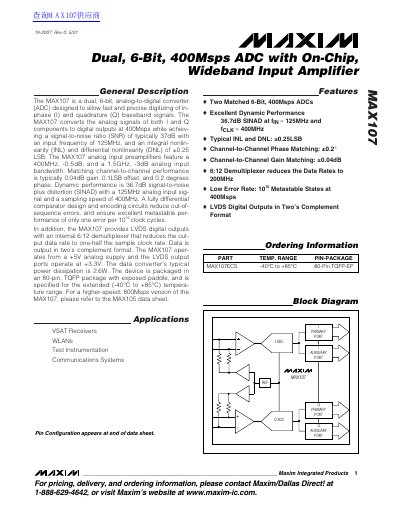
The MAX107 is a dual, 6-bit analog-to-digital converter (ADC) designed for fast and precise digitizing of in-phase (I) and quadrature (Q) baseband signals. It converts analog signals to digital outputs at 400Msps with a typical signal-to-noise ratio of 37dB and an input frequency of 125MHz. The device includes an internal 6:12 demultiplexer that reduces the output data rate to one-half the sample clock rate.
| Resolution | 6 Bits |
|---|---|
| Sampling Rate | 400Msps |
| Signal-to-Noise Ratio | 37dB |
| Input Frequency | 125MHz |
| Analog Input Bandwidth | 400MHz, -0.5dB |
| Operating Temperature Range | -40°C to +85°C |
| Package | 80-pin TQFP |
| Analog Supply Voltage | +5V |
| Digital Supply Voltage | +3.3V |
The typical power dissipation is 2.6W.
Yes, it provides an internal 6:12 demultiplexer.
It ensures only one error per 10^16 clock cycles.