
The LMX2470 is a low power, high performance delta-sigma fractional-N PLL with an auxiliary integer-N PLL. It is fabricated using National Semiconductor’s advanced BiCMOS process. The delta-sigma architecture allows for fractional spur compensation by utilizing the noise shaping capability of the delta-sigma modulator and the low pass filtering of the PLL loop filter. This pushes fractional spurs at lower frequencies to higher frequencies outside the loop bandwidth. The digital feedback techniques used in the LMX2470 are resistant to changes in temperature and variations in wafer processing, unlike analog compensation. The ability to push close in spur and phase noise energy to higher frequencies is directly related to the modulator order, with higher orders allowing for more energy spread to higher frequencies. The LMX2470 has a programmable modulator with a maximum order of four, allowing the designer to select the optimal modulator order for the system's phase noise, spur, and lock time requirements. Programming is simple and fast using a three line MICROWIRE interface. The LMX2470 operates at a nominal supply voltage of 2.5V and has a typical current consumption of 4.1mA. It is available in a 24 lead 3.5 X 4.5 X 0.6 mm package.
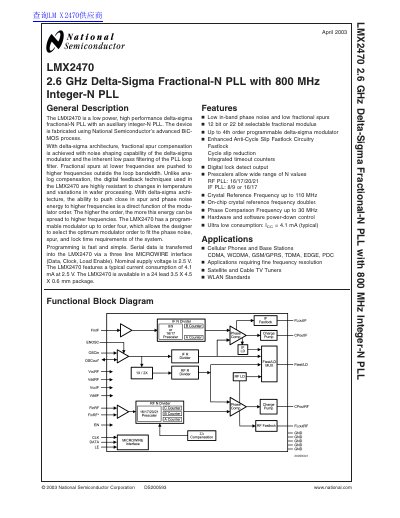
The LMX2470 is a low power, high performance delta-sigma fractional-N phase-locked loop (PLL) featuring an auxiliary integer-N PLL. Fabricated using National Semiconductor's advanced BiCMOS process, the device utilizes digital feedback techniques to achieve fractional spur compensation that is highly resistant to temperature and wafer processing variations.
The chip supports a programmable modulator up to order four, allowing designers to optimize phase noise, spur performance, and lock time. Programming is handled via a simple three-line MICROWIRE interface (Data, Clock, Load Enable) with a nominal supply voltage of 2.5 V. The device features enhanced anti-cycle slip fastlock circuitry and integrated timeout counters.
| Operating Frequency (RF Synthesizer) | 500 to 2600 MHz |
|---|---|
| Operating Frequency (IF Synthesizer) | 75 to 800 MHz |
| Phase Detector Frequency (RF) | 30 MHz |
| Phase Detector Frequency (IF) | 10 MHz |
| Crystal Reference Frequency | up to 110 MHz |
| Power Supply Voltage | 2.25 V to 2.75 V |
| Typical Current Consumption | 4.1 mA |
| Package Type | 24 lead CSP (SLE) |
The RF synthesizer operates from 500 MHz to 2600 MHz.
The nominal supply voltage is 2.5 V, with an operating range of 2.25 V to 2.75 V.
The device is available in a 24 lead CSP (SLE) package.