
The LMC6084 is a precision quad low offset voltage operational amplifier, capable of single supply operation. Performance characteristics include ultra low input bias current, high voltage gain, rail-to-rail output swing, and an input common mode voltage range that includes ground. These features, plus its low offset voltage, make the LMC6084 ideally suited for precision circuit applications. Other applications using the LMC6084 include precision full-wave rectifiers, integrators, references, and sample-and-hold circuits. This device is built with National’s advanced Double-Poly Silicon-Gate CMOS process. For designs with more critical power demands, see the LMC6064 precision quad micropower operational amplifier. For a single or dual operational amplifier with similar features, see the LMC6081 or LMC6082 respectively.
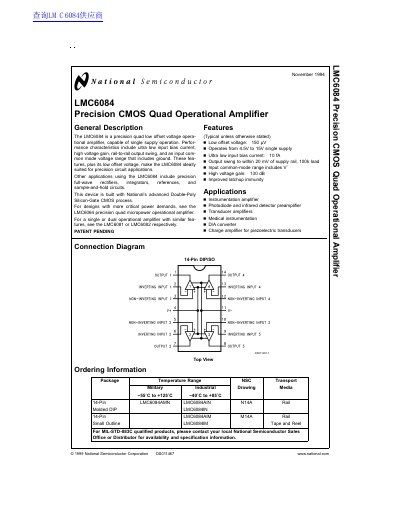
The LMC6084 is a precision quad low offset voltage operational amplifier capable of single supply operation. It features ultra-low input bias current, high voltage gain, rail-to-rail output swing, and an input common-mode voltage range that includes ground. These characteristics make it ideally suited for precision circuit applications such as instrumentation amplifiers, photodiode preamplifiers, and medical instrumentation.
| Input Offset Voltage (Typical) | 150 µV |
|---|---|
| Supply Voltage Range | 4.5V to 15V |
| Input Bias Current | 10 fA |
| Output Swing | 20 mV of supply rail |
| Voltage Gain | 130 dB |
| Input Common-Mode Range | Includes V− |
| Gain-Bandwidth Product | 1.3 MHz |
| Input-Referred Voltage Noise | 22 nV/√Hz |
Applications include instrumentation amplifiers, photodiode and infrared detector preamplifiers, transducer amplifiers, medical instrumentation, D/A converters, and charge amplifiers for piezoelectric transducers.
Yes, the device is capable of single supply operation with a voltage range of 4.5V to 15V.
The typical input bias current is 10 fA, which is ultra-low.
The effect of input capacitance can be compensated for by adding a capacitor, Cf, around the feedback resistors.