
The BUK109-50GS is a monolithic temperature and overload protected power MOSFET in a 3 pin plastic surface mount envelope, intended as a general purpose switch for automotive systems and other applications.
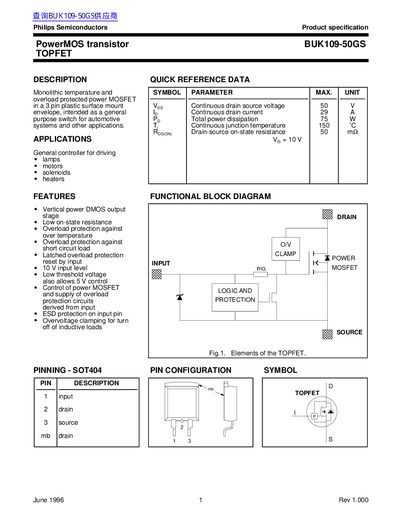
The document describes the BUK109-50GS, a PowerMOS transistor featuring vertical DMOS output stage technology. It is designed as a general-purpose switch for automotive systems and other applications, offering protection against over-temperature and short-circuit loads.
Key features include low on-state resistance, latched overload protection reset by input voltage, and overvoltage clamping for inductive loads. The device operates within a continuous junction temperature range of up to 150 °C and is packaged in an SOT404 surface mount envelope.
| Continuous drain source voltage | 50 V |
|---|---|
| Continuous drain current (Tj=25°C) | 29 A |
| Total power dissipation | 75 W |
| Continuous junction temperature | 150 °C |
| Package type | SOT404 |
It is intended as a general purpose switch for automotive systems and other applications, suitable for driving lamps, motors, solenoids, and heaters.
The device features overload protection against over temperature, which operates at a threshold junction temperature of 150 °C.
The device remains latched off until it is reset by applying a voltage to the input pin.