
This Technical Note compares the Agilent 1100 Series diode array detector (DAD) “B” model to its successor the Agilent 1200 Series DAD “D model”. For this comparison both detectors were interchangeably connected to an Agilent 1100 Series LC system. To exclude undesired instrument bias the same Agilent 1100 Series LC system was used for both series of experiments. The evaluated performance criteria included retention time, peak width, resolution, peak area, peak height, signal-to-noise, limit of detection, limit of quantitation and linearity. Overall, the Agilent 1200 Series DAD compared favorably to the Agilent 1100 Series DAD, delivering the same or even noticeably better results. Based on these results it was concluded that an Agilent ChemStation method that was developed and validated on an 1100 Series DAD is fully compatible with the 1200 Series DAD. This means that an 1100 Series DAD can be replaced by a 1200 Series DAD with no or minimal revalidation effort.
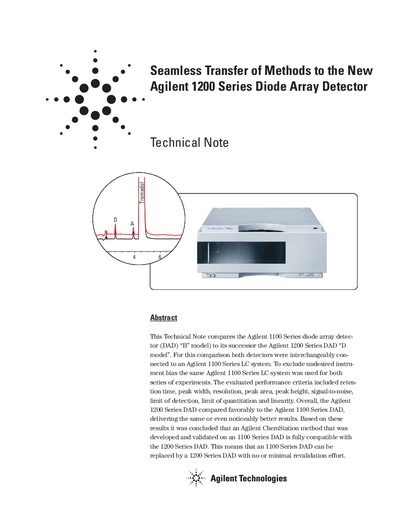
This document is a technical note comparing the performance of the Agilent 1100 Series diode array detector (DAD) "B" model with its successor, the Agilent 1200 Series DAD "D" model. The comparison was conducted by interchanging the detectors on an Agilent 1100 Series LC system while keeping all other conditions constant. The study evaluated various performance criteria including retention time, peak width, resolution, signal-to-noise, limit of detection, and linearity using specific pharmaceutical samples like tramadol and nifedipin.
The system requires ChemStation revision B.01.03 SR 2 or higher, or B.2.01 SR 2 or higher.
The standard flow cell has a volume of 13-pL.
The stop time for that specific analysis was 16 min.