
Series 2 UNITY Thermal desorber is a universal TD platform for tagged and untagged tubes. Series 2 UNITY Thermal Desorption – GC(MS) Thermal desorption is a highly versatile, sensitive and labour-saving sample preparation technique for the measurement of volatile and semi-volatile organic compounds (VOC and SVOC) in air and materials. It provides the ultimate sample introduction technology for GC/GCMS combining selective concentration enhancement with direct extraction into the carrier gas and efficient transfer/injection all in one fully automated and labour saving package. TD is applicable to GC-compatible organics ranging in volatility from acetylene and freons to high boilers such as n-C40, phthalate plasticisers and benzo-α-pyrene. It also offers quantitative concentration for some inorganic gases including; nitrous oxide, SF6, CS2 and H2S. Key applications include: Environmental and workplace air monitoring Civil defence and forensic analysis Materials and materials emissions testing Food, flavour and fragrance profiling
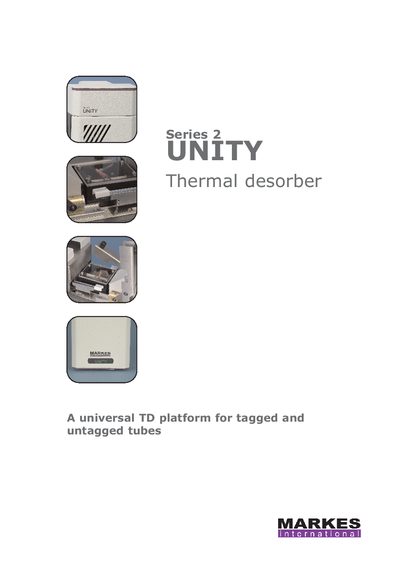
The Markes International UNITY 2 is a next-generation thermal desorption (TD) system designed as a single platform for all TD applications. It combines tube desorption with cryogen-free analyte re-focusing to provide quantitative concentration of volatile and semi-volatile organic compounds (VOCs and SVOCs). The system supports both tagged and untagged tubes, offering full compliance with international standard methods such as EN ISO 16017, US EPA TO-15/TO-17, and NIOSH 2549.
| Sorbent Trap Cooling Temperature | -30°C |
|---|---|
| Sorbent Bed Length | 60 mm |
| Tube Desorption Temperature | Above 400°C |
Thermal desorption offers typically 1000-fold enhancement in sensitivity, greatly enhanced recovery (>95%), reusable sample tubes, no toxic solvent required and reduced analytical interference.
Yes, it uses electrically-cooled sorbent trapping to -30°C which eliminates ice plug formation and reduces running costs.
Yes, via SecureTD-Q™ which overcomes the one-shot limitation of conventional TD systems by allowing quantitative re-collection of split flow.