
This document describes a refinery gas analyzer that uses a flame ionization detector (FID) to detect C1 to C7 paraffins and olefins, with a lower detection limit of 20 ppm. The analyzer can be optionally configured with liquid sample valves for the injection of pressurized liquid samples. It is also capable of analyzing trace sulfurs in refinery gas, heavy hydrocarbons, and trace CO. Additionally, it can be customized to perform specific ASTM and ISO tests. The analyzer offers high temperature injection for heavy fractions and can analyze reactor effluent gases using a TCD/TCD/MSD configuration. The entire analysis has a run time of less than 15 minutes.
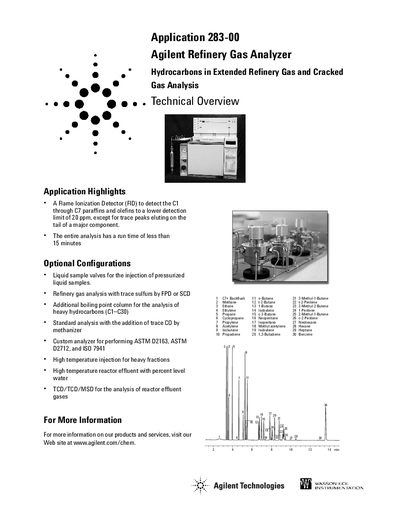
This document provides a technical overview of the Agilent Refinery Gas Analyzer, specifically Application 283-00. It details the use of a Flame Ionization Detector (FID) to detect C1 through C7 paraffins and olefins with a lower detection limit of 20 ppm.
The analyzer detects C1 through C7 paraffins and olefins to a lower detection limit of 20 ppm.
The entire analysis has a run time of less than 15 minutes.
The custom analyzer is capable of performing ASTM D2163, ASTM D2712, and ISO 7941.