
The DAC1220 is a 20-bit low-power digital-to-analog converter with 20-bit monotonic performance over the specified temperature range of -40°C to +85°C. It utilizes delta-sigma technology to achieve inherently linear performance in a small package at very low power. The resolution of the device can be programmed to 20 bits, settling to 0.003% within 15ms typical, or 16 bits, settling to 0.012% within 2ms max. The output range is two times the external reference voltage. On-chip calibration circuitry dramatically reduces low offset and gain errors. The DAC1220 features a synchronous serial interface. In single-converter applications, the serial interface can be accomplished with just two wires, allowing low-cost isolation. For multiple converters, a CS signal allows for selection of the appropriate D/A converter. The DAC1220 has been designed for closed-loop control applications in the industrial process control market and high-resolution applications in the test and measurement market. It is also ideal for remote applications, battery-powered instruments, and isolated systems.
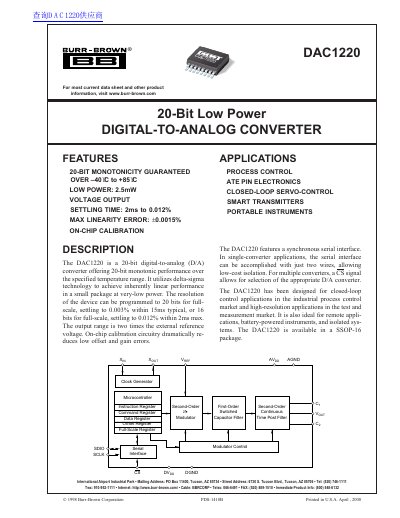
The document is a technical datasheet for the Burr-Brown DAC1220E, a 20-bit low-power digital-to-analog converter. It utilizes delta-sigma technology to achieve inherent linearity in a small SSOP-16 package at very-low power consumption.
Key features include guaranteed monotonicity over an industrial temperature range of -40°C to +85°C, on-chip calibration circuitry to reduce offset and gain errors, and a synchronous serial interface. The device is designed for applications such as process control, ATE pin electronics, closed-loop servo-control, smart transmitters, and portable instruments.
| Resolution | 20-bit (programmable to 16-bit) |
|---|---|
| Power Dissipation | 3.5 mW (typical) |
| Settling Time | 2ms to 0.012% |
| Max Linearity Error | 0.0015% |
| Operating Temperature Range | -40°C to +85°C |
| Package Type | SSOP-16 |
Yes, it features on-chip calibration circuitry that dramatically reduces low offset and gain errors.
The device operates at very-low power with a typical dissipation of 2.5mW.