
OPA551 and OPA552 are low cost op amps with high-voltage (60V) and high-current (200mA) capability. The OPA551 is unity-gain stable and features high slew rate (15Vµs) and wide bandwidth (3MHz). The OPA552 is optimized for gains of 5 or greater, and offers higher speed with a slew rate of 24V/µs and a bandwidth of 12MHz. Both are suitable for telephony, audio, servo, and test applications. These laser-trimmed, monolithic integrated circuits provide excellent low-level accuracy along with high output swing. High performance is maintained as the amplifier swings to its specified limits. The OPA551 and OPA552 are internally protected against over-temperature conditions and current overloads. The thermal shutdown indicator “flag” provides a current output to alert the user when thermal shutdown occurs.
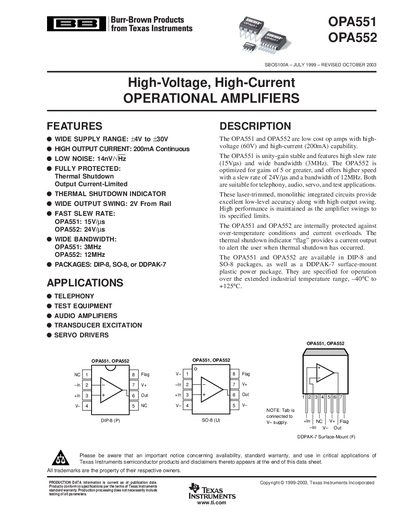
The OPA551 and OPA552 are high‑voltage (up to 60 V) and high‑current (200 mA) operational amplifiers. They offer a wide supply range of +4 V to +30 V, low noise (14 nV/√Hz), and fast slew rates of 15 V/µs (OPA551) and 24 V/µs (OPA552). Their gain‑bandwidth products are 3 MHz and 12 MHz respectively, making them suitable for precision analog applications.
Typical applications include telephony, test equipment, audio amplifiers, transducer excitation, and servo drivers. The devices are offered in DIP‑8, SO‑8, and DDPAK‑7 packages and are rated for operation from –40 °C to +125 °C.
| Supply Voltage Range | +4 V to +30 V |
|---|---|
| Continuous Output Current | 200 mA |
| Slew Rate (OPA551) | 15 V/µs |
| Slew Rate (OPA552) | 24 V/µs |
| Gain‑Bandwidth Product (OPA551) | 3 MHz |
| Gain‑Bandwidth Product (OPA552) | 12 MHz |
| Input Voltage Noise Density | 14 nV/√Hz |
| Input Bias Current | 20 pA |
| Operating Temperature Range | –40 °C to +125 °C |
| Available Packages | DIP‑8, SO‑8, DDPAK‑7 |
Both devices can deliver up to 200 mA continuous output current.
They operate from +4 V up to +30 V.
Typical applications include telephony, test equipment, audio amplifiers, transducer excitation, and servo drivers.
They are offered in DIP‑8, SO‑8, and DDPAK‑7 packages.