
The OPA130 series of FET-input op amps combine precision dc performance with low quiescent current. Single, dual, and quad versions have identical specifications for maximum design flexibility. They are ideal for general-purpose, portable, and battery operated applications, especially with high source impedance. OPA130 op amps are easy to use and free from phase inversion and overload problems often found in common FET-input op amps. Input cascode circuitry provides excellent common-mode rejection and maintains low input bias current over its wide input voltage range. OPA130 series op amps are stable in unity gain and provide excellent dynamic behavior over a wide range of load conditions, including high load capacitance. Dual and quad designs feature completely independent circuitry for lowest crosstalk and freedom from interaction, even when overdriven or overloaded. Single and dual versions are available in 8-pin DIP and SO-8 surface-mount packages. Quad is available in 14-pin DIP and SO-14 surface-mount packages. All are specified for –40°C to +85°C operation.
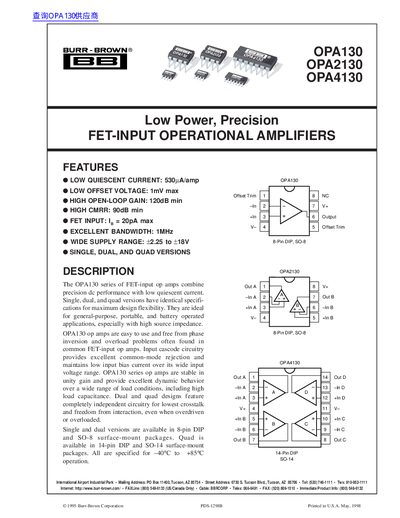
The OPA130 series of FET-input operational amplifiers combines precision DC performance with low quiescent current. Available in single, dual, and quad versions, these devices are ideal for general-purpose, portable, and battery-operated applications, particularly those involving high source impedance. The series is noted for being free from phase inversion and overload problems often found in common FET-input op amps.
| Low Quiescent Current | 530 µA/amp |
|---|---|
| Low Offset Voltage | 1mV max |
| High Open-Loop Gain | 120dB min |
| High CMRR | 90dB min |
| Input Bias Current | 20pA max |
| Excellent Bandwidth | 1MHz |
| Wide Supply Range | ±2.25 to ±18V |
| Operating Temperature Range | –40 °C to +85 °C |
They are ideal for general-purpose, portable, and battery operated applications, especially with high source impedance.
Yes, OPA130 series op amps are stable in unity gain and provide excellent dynamic behavior over a wide range of load conditions.
Yes, dual and quad designs feature completely independent circuitry for lowest crosstalk and freedom from interaction, even when overdriven or overloaded.