
The MAX6314 low-power CMOS microprocessor (μP) supervisory circuit is designed to monitor power supplies in μP and digital systems. The MAX6314’s RESET output is bidirectional, allowing it to be directly connected to μPs with bidirectional reset inputs, such as the 68HC11. It provides excellent circuit reliability and low cost by eliminating external components and adjustments. The MAX6314 also provides a debounced manual reset input. This device performs a single function: it asserts a reset signal whenever the VCC supply voltage falls below a preset threshold or whenever manual reset is asserted. Reset remains asserted for an internally programmed interval (reset timeout period) after VCC has risen above the reset threshold or manual reset is deasserted. The MAX6314 comes with factory-trimmed reset threshold voltages in 100mV increments from 2.5V to 5V. Preset timeout periods of 1ms, 20ms, 140ms, and 1120ms (minimum) are also available. The device comes in a SOT143 package. For a μP supervisor with an open-drain reset pin, see the MAX6315 data sheet.
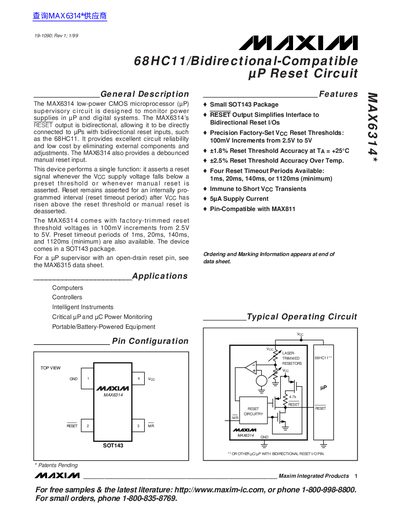
The MAX6314 is a low-power CMOS microprocessor supervisory circuit designed to monitor power supplies in uP and digital systems. It features a bidirectional RESET output, allowing direct connection to microprocessors with bidirectional reset inputs, such as the Motorola 68HC11. The device eliminates the need for external components by providing factory-trimmed reset threshold voltages and selectable timeout periods.
| Reset Threshold Accuracy (Ta = +25°C) | +/- 1.8% |
|---|---|
| Reset Timeout Periods | 1ms, 20ms, 140ms, or 1120ms (minimum) |
| Package Type | SOT143 |
| Operating Temperature Range | -40°C to +85°C |
The reset threshold accuracy is +/- 1.8% at +25°C.
Yes, the RESET output is bidirectional, allowing it to be directly connected to uPs with bidirectional reset inputs, such as the 68HC11.
The available reset timeout periods are 1ms, 20ms, 140ms, or 1120ms (minimum).