
The CAT5251 is four Digitally Programmable Potentiometers (DPPs™) integrated with control logic and 16 bytes of NVRAM memory. Each DPP consists of a series of resistive elements connected between two externally accessible end points. The tap points between each resistive element are connected to the wiper outputs with CMOS switches. A separate 8-bit control register (WCR) independently controls the wiper tap switches for each DPP. Associated with each wiper control register are four 8-bit non-volatile memory data registers (DR) used for storing up to four wiper settings. Writing to the wiper control register or any of the non-volatile data registers writes the data to the NVRAM memory.
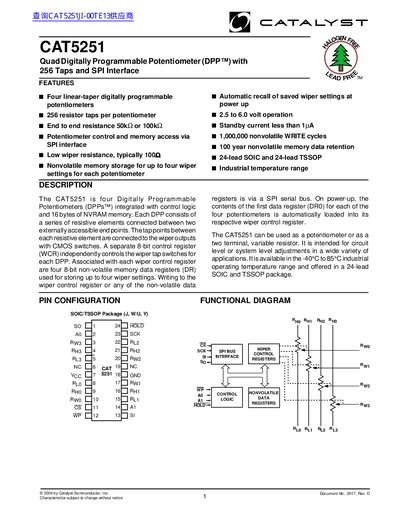
The Catalyst CAT5251 is a quad Digitally Programmable Potentiometer (DPP) integrated with control logic and 16 bytes of NVRAM memory. It features four linear-taper digitally programmable potentiometers with 256 resistor taps per potentiometer and an end-to-end resistance of 50kΩ or 100kΩ. The device operates on a 2.5 to 6.0 volt supply and includes an SPI interface for control and memory access.
The CAT5251 supports automatic recall of saved wiper settings at power-up and offers up to 1,000,000 nonvolatile write cycles with 100-year data retention. It is available in 24-lead SOIC and TSSOP packages with an industrial temperature range of -40°C to +85°C. The device can be used as a potentiometer or a two-terminal variable resistor for circuit or system-level adjustments.
| Resistor Taps | 256 |
|---|---|
| Operating Voltage | 2.5V to 6.0V |
| End-to-End Resistance | 50kΩ or 100kΩ |
| Interface Type | SPI |
| Nonvolatile Write Cycles | 1,000,000 |
| Memory Retention | 100 years |
| Package Types | 24-lead SOIC and 24-lead TSSOP |
| Operating Temperature Range | -40°C to +85°C |
| Wiper Resistance (Typical) | 100Ω |
The device operates on a 2.5 to 6.0 volt supply.
Each potentiometer has 256 resistor taps.
The end-to-end resistance is either 50kΩ or 100kΩ.