
The ADN2882 is a compact, high performance 3.3 V power supply SiGe transimpedance amplifier (TIA) optimized for small form factor 4.25Gbps optical modules compliant with SFF-8472 receivers, PIN/APD-TIA receive optical subassembly, SONET/GbE/FC optical receivers, transceivers, and transponders.
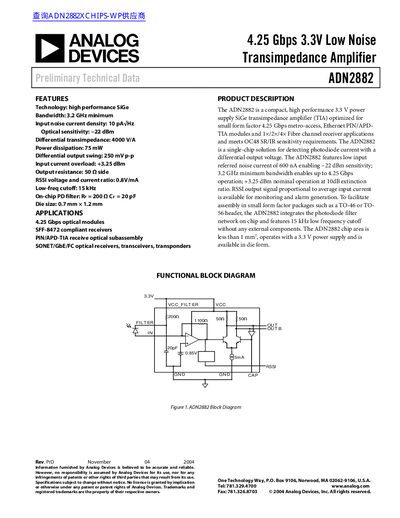
The Analog Devices ADN2882 is a compact, high-performance single-chip solution designed as a 3.3 V power supply SiGe transimpedance amplifier (TIA). It is optimized for small form factor 4.25 Gbps metro-access Ethernet PIN/APD-TIA modules and 1x/2x/4x Fibre channel receiver applications, meeting OC48 SR/IR sensitivity requirements.
The device features a low input referred noise current of 600 nA enabling -22 dBm sensitivity and a minimum bandwidth of 3.2 GHz for up to 4.25 Gbps operation. It includes an on-chip photodiode filter network with a 15 kHz low frequency cutoff, allowing assembly in small form factor packages like TO-46 or TO-56 headers without external components.
| Bandwidth (BW) -3 dB | 3.2 GHz minimum |
|---|---|
| Input noise current density | 10 pA/√Hz |
| Optical sensitivity | -22 dBm |
| Differential transimpedance | 4000 V/A |
| Power dissipation | 75 mW |
| Output resistance | 50 Ω |
| Die size | 0.7 mm x 1.2 mm |
The device has a minimum bandwidth of 3.2 GHz.
The operating ambient temperature range is -40°C to +95°C.