
The TK5530 is a complete transponder used for car immobilization, access control, alarm systems, and other identification systems. It consists of a plastic cube with an e5530 IDIC chip and a tuned circuit antenna. The e5530 chip stores 128 bits of read-only data, which is transmitted to the base station via an RF field. The product has anti-counterfeiting features.
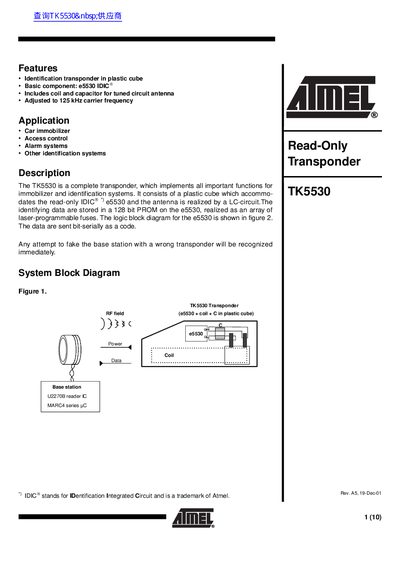
The document describes the Atmel TK5530, a complete plastic cube transponder designed for immobilizer and identification systems. It integrates a read-only IDentification Integrated Circuit (IDIC) with an antenna tuned to a nominal carrier frequency of 125 kHz.
Key features include a 128-bit PROM storing unique codes via laser-programmable fuses, Manchester or Bi-phase encoding options, and operation within a temperature range of -40°C to +85°C. The datasheet provides specifications for inductance, resonance frequency, magnetic field strength requirements, and ordering information for both standard and customized versions.
| Nominal Frequency | 125 kHz |
|---|---|
| Memory Size | 128 bit PROM |
| Operating Temperature Range | -40 to +85 °C |
| Inductance | 3.95 mH |
| Resonance Frequency (Typical) | 125 kHz |
A distance of 10 cm and more can be obtained with an appropriate field, though typical distances on demo boards are 0 to 5 cm.
The transponder supports Manchester or Bi-phase encoding.