
The UC1852 provides a low-cost solution to active power-factor correction (PFC) for systems that would otherwise draw high peak current pulses from AC power lines. This circuit implements zero-current switched boost conversion, producing sinusoidal input currents with a minimum of external components, while keeping peak current substantially below that of fully-discontinuous converters. The UC1852 provides controlled switch on-time to regulate the output bulk DC voltage, an off-time defined by the boost inductor, and a zero-current sensing circuit to reactivate the switch cycle. Even though switching frequency varies with both load and instantaneous line voltage, it can be maintained within a reasonable range to minimize noise generation. While allowing higher peak switch currents than continuous PFCs such as the UC1854, this device offers less external circuitry and smaller inductors, yet better performance and easier line-noise filtering than discontinuous current PFCs with no sacrifice in complexity or cost. The ability to obtain a power factor in excess of 0.99 makes the UC1852 an optimum choice for low-cost applications in the 50 to 5.
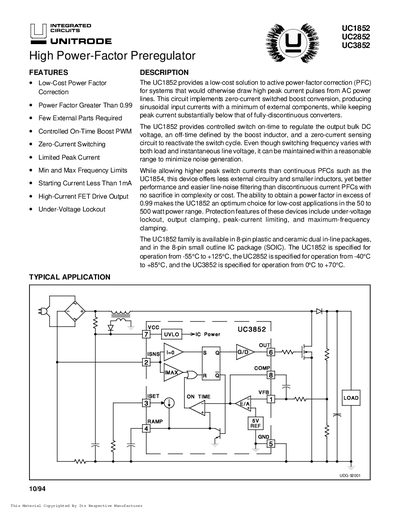
This document is a technical datasheet for the Unitrode UC1852 family of integrated circuits, specifically designed as low-cost solutions for active power factor correction (PFC). The devices utilize zero-current switched boost conversion to regulate output bulk DC voltage while maintaining sinusoidal input currents with minimal external components.
| Power Factor | Greater Than 0.99 |
|---|---|
| Operating Temperature (UC1852) | -55°C to +125°C |
| Operating Temperature (UC2852) | -40°C to +85°C |
| Operating Temperature (UC3852) | 0°C to +70°C |
| Package Types | 8-pin plastic and ceramic dual in-line packages, and 8-pin small outline IC package (SOIC) |
| ISET Voltage | 5.0 V Typ |
The UC1852 provides a low-cost solution to active power-factor correction (PFC) for systems that would otherwise draw high peak current pulses from AC power lines.
It implements zero-current switched boost conversion, producing sinusoidal input currents with a minimum of external components.