
The LTC2854 and LTC2855 are 3.3V RS485 transceivers with integrated termination resistors. They feature ESD protection, balanced thresholds, high input resistance, and full failsafe output. These devices can enable or disable the termination resistors with simple logical control for network configuration and reconfiguration.
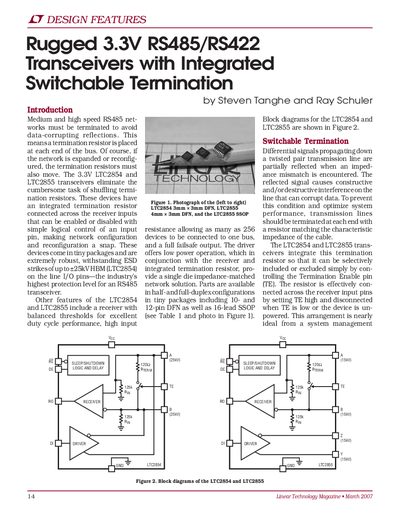
This document details the design features of the LTC2854 (half-duplex) and LTC2855 (full-duplex) RS485/RS422 transceivers. A key feature is the integrated, switchable termination resistor that eliminates the need to physically move resistors when expanding or reconfiguring a network bus.
The devices also include a balanced threshold receiver with full failsafe output, allowing for excellent duty cycle performance even over long cable runs (up to 4000 feet). The driver supports data rates up to 20Mbps and offers protection against short circuits.
| Data Rate (Max) | 20Mbps |
|---|---|
| ESD Protection (LTC2854) | +25kV HBM |
| Max Devices per Bus | 256 |
| Receiver Current Draw | 450µA |
The termination resistor is connected across the receiver inputs and can be enabled or disabled by controlling a single input pin (TE).
Up to 256 devices can be connected to a single bus due to high input resistance.
The differential driver delivers signals at data rates up to 20Mbps.