
The LT1785/LT1791 are half-duplex and full-duplex differential bus transceivers for RS485 and RS422 applications which feature on-chip protection from overvoltage faults on the data transmission lines. Receiver input and driver output pins can withstand voltage faults up to ±60V with respect to ground with no damage to the device. Faults may occur while the transceiver is active, shut down or powered off. Data rates to 250kbaud on networks of up to 128 nodes are supported. Controlled slew rates on the driver outputs control EMI emissions and improve data transmission integrity on improperly terminated lines. Drivers are specified to operate with inexpensive cables as low as 72Ω characteristic impedance. The LT1785A/LT1791A devices have “fail-safe” receiver inputs to guarantee a receiver output high for shorted, open or inactive data lines. On-chip ESD protection eliminates need for external protection devices. The LT1785/LT1785A are available in 8-lead DIP and SO packages and the LT1791/LT1791A in 14-lead DIP and SO packages.
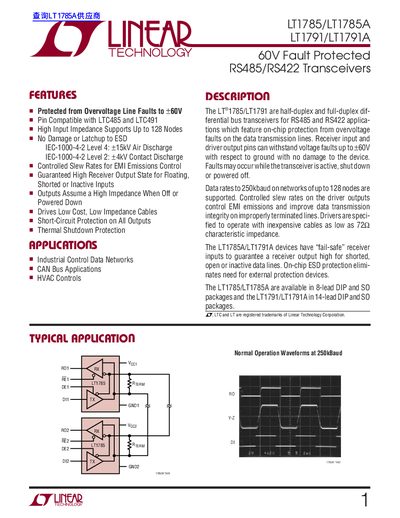
The LT1785/LT1785A and LT1791/LT1791A are half-duplex and full-duplex differential bus transceivers designed for RS485 and RS422 applications. These devices feature on-chip protection from overvoltage faults on data transmission lines, allowing receiver input and driver output pins to withstand voltage faults up to +60V with respect to ground without damage.
Data rates up to 250kbaud are supported on networks of up to 128 nodes. The transceivers include controlled slew rates for EMI emissions control and drivers specified to operate with inexpensive cables as low as 72Ω characteristic impedance. Available in 8-lead and 14-lead DIP and SO packages, they support industrial control data network applications.
| Overvoltage Fault Protection | +60V |
|---|---|
| Maximum Data Rate | 250 kbps |
| Driver Short-Circuit Current | 250 mA |
The receiver input and driver output pins can withstand voltage faults up to +60V with respect to ground.
Data rates of 250kbaud are supported on networks of up to 128 nodes.
The devices are available in 8-lead DIP and SO packages, as well as 14-lead DIP and SO packages.