
LT1638/LT1639 are super micro power rail-to-rail input and output operational amplifiers with a frequency of 1.2MHz and a slew rate of 0.4V/µs. They operate with inputs above V+, have low power consumption, high output current, etc. They are suitable for portable instrumentation, sensor conditioning, battery monitoring, micro power active filters, 4mA to 20mA transmitters, etc.
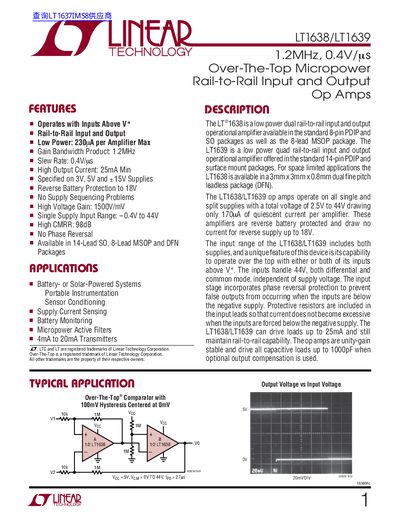
The document describes the LT1638, a low power dual operational amplifier, and the LT1639, a low power quad operational amplifier. Both devices feature rail-to-rail input and output capabilities, allowing them to operate with inputs above the positive supply voltage (Over-The-Top). They are designed for battery-powered systems, portable instrumentation, and sensor conditioning applications.
| Gain Bandwidth Product | 1.2MHz |
|---|---|
| Slew Rate | 0.4V/us |
| Supply Current per Amplifier | 230uA Max |
| High Output Current | 25mA Min |
| Input Voltage Range (Single Supply) | -0.4V to 44V |
| Common Mode Rejection Ratio | 98dB |
Yes, they feature a unique capability to operate over the top with either or both inputs above V+.
Each amplifier draws only 170uA of quiescent current.
The output can be short-circuited for continuous operation.