
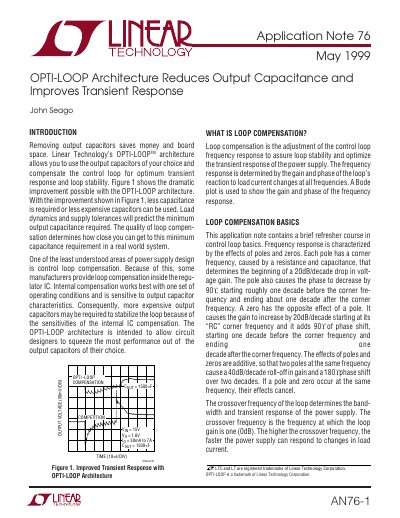
The document introduces the OPTI-LOOP architecture, which allows designers to use custom output capacitors while maintaining loop stability and optimizing transient performance. Unlike internal compensation methods that are sensitive to component variations, this external approach enables the selection of cost-effective capacitors without sacrificing system reliability.
The text provides a technical refresher on control loop basics, detailing how poles and zeros affect frequency response. It explains the relationship between output capacitance, load resistance, and ESR in determining loop stability margins and crossover frequency for current-mode switching regulators.
It allows designers to use output capacitors of their choice while compensating the control loop for optimum transient response and stability.
Internal compensation works best with one set of operating conditions and may require more expensive capacitors, whereas OPTI-LOOP allows designers to squeeze the most performance out of their chosen components.
The crossover frequency determines the bandwidth and transient response; a higher crossover frequency allows for a faster response to load current changes.