
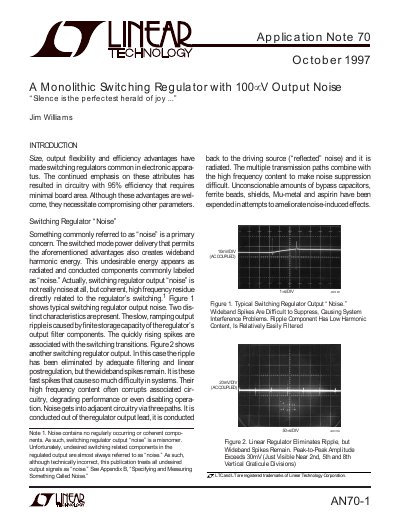
Linear Technology AN70-1 Switching Regulator Application Note


Linear Technology AN70-1 Switching Regulator Application Note - cover page
Brand
Linear Technology
Category
Power Management
Document type
Application Note
Language
English
Pages
72
File format
PDF
File size
1.7 MB
Published
05 June, 2012
Updated
29 September, 2023
MD5 checksum
E30A10586716C37FF0B235B885838194

About this manual

The document addresses the issue of "noise" in switching regulators, clarifying that it is actually coherent, high-frequency residue related to the regulator's switching rather than random noise. It explains how this energy appears as radiated and conducted components that can corrupt adjacent circuitry.

The text introduces a practical approach using the LT1533 monolithic regulator designed for low-noise switching supplies. This device utilizes slew-controlled output stages to minimize harmonic content during switching transitions, thereby reducing wideband spikes while maintaining efficiency.

What's inside

  • Introduction
  • Switching Regulator Noise Characteristics
  • Noise Paths and Suppression Difficulties
  • Low Noise Switching Regulator Approach
  • LT1533 Monolithic Regulator Description
  • Pin Function Descriptions
  • Output Stage Design
  • Measuring Output Noise

Specifications

Input Voltage Range2.7V to 30V
Undervoltage Lockout Threshold2.55V
Shutdown Current (ISHDN)20µA

Frequently asked questions

What is the actual nature of switching regulator output noise?

It is not random noise but coherent, high frequency residue directly related to the regulator's switching.

What is the input voltage range for the LT1533 regulator?

The VIN pin accepts an input supply in a 2.7V to 30V range.

What is the maximum output noise level of the LT1533?

The regulator achieves a performance of 100µV noise in a 100MHz bandwidth.

What is the current rating of each output transistor?

Each power transistor operates at a 1A capacity.

Download PDF (1.7 MB)

More Linear Technology Manuals


View all Linear Technology manuals →