
The ADP3000 is a high-frequency switching regulator from Analog Devices. It features low power consumption, wide input voltage range, adjustable output voltage, and few external components. It is mainly used in notebook computers, palmtop computers, cellular phones, hard disk drives, portable instruments, pagers, etc.
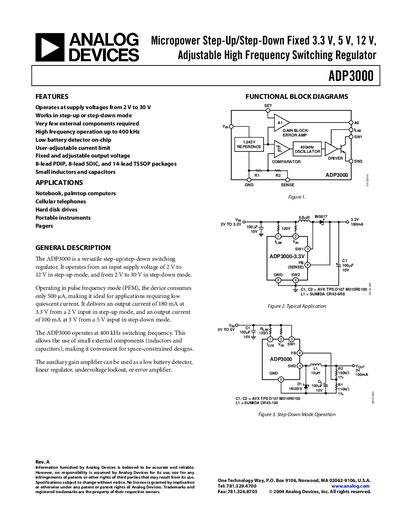
The ADP3000 is a micropower step‑up/step‑down switching regulator from Analog Devices. It operates from 2 V to 30 V input, supports both boost and buck modes, and runs at up to 400 kHz, allowing the use of small external inductors and capacitors. It includes on‑chip low‑battery detection and a user‑adjustable current limit.
The device is offered in fixed‑output versions (3.3 V, 5 V, 12 V) and an adjustable version, packaged in 8‑lead PDIP (N‑8), 8‑lead SOIC (R‑8), and 14‑lead TSSOP (RU‑14). Typical applications include notebook computers, cellular phones, portable instruments, and other space‑constrained designs.
| Input voltage (step‑up mode) | 2.0 V to 12.6 V |
|---|---|
| Input voltage (step‑down mode) | up to 30 V |
| Oscillator frequency | 350 kHz to 450 kHz |
| Output current (3.3 V version) | 180 mA |
| Maximum power dissipation | 500 mW |
The step‑up mode accepts an input voltage from 2.0 V to 12.6 V.
The device operates at a switching frequency up to 400 kHz.
It is offered in 8‑lead PDIP (N‑8), 8‑lead SOIC (R‑8), and 14‑lead TSSOP (RU‑14) packages.