
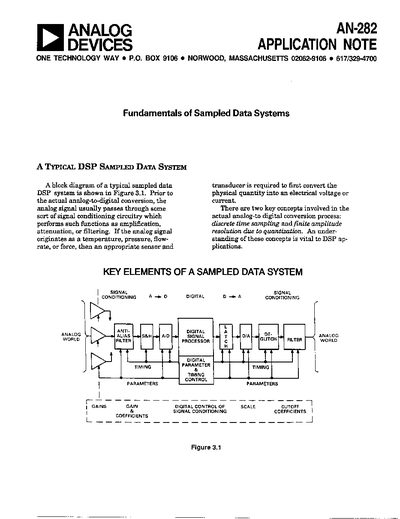
Analog Devices AN-282 Application Note


Analog Devices AN-282 Application Note - cover page
Brand
Analog Devices
Category
Other Electronics
Document type
Application Note
Language
English
Pages
21
File format
PDF
File size
2.1 MB
Published
04 June, 2012
Updated
27 June, 2012
MD5 checksum
41CDA268814F67647C867E2B63FBF390

About this manual

The note introduces the basic concepts of sampled‑data systems, including discrete‑time sampling, Nyquist’s criterion, and the effects of aliasing on signal integrity. It describes how insufficient sampling rates cause loss of information and outlines the role of anti‑aliasing filters.

It then discusses practical filter design, showing how filter order and stop‑band attenuation relate to desired dynamic range, and covers oversampling, decimation, and quantization effects. Formulas for SNR, effective number of bits (ENOB), and ADC resolution selection are provided, along with example calculations.

What's inside

  • Fundamentals of Sampled Data Systems
  • Key Elements of a Sampled Data System
  • Discrete Time Sampling of Analog Signals
  • Selection of Antialiasing Filters
  • Antialiasing Filter Requirements
  • Antialiasing Filter Example
  • Oversampling and Decimation
  • Undersampling and Its Applications
  • Quantization Theory, Signal to Noise Ratio, and Effective Bits
  • Selection of ADC Resolution Based on Signal Dynamic Range

Frequently asked questions

What is the Nyquist criterion for sampling?

The signal must be sampled at a rate greater than twice its bandwidth to avoid loss of information.

How many poles are required for a 60 dB antialiasing filter?

Approximately 10 poles are needed to achieve 60 dB attenuation.

What is the formula for the SNR of an ideal ADC?

SNR = 6.02 N + 1.76 dB.

Download PDF (2.1 MB)

More Analog Devices Manuals


View all Analog Devices manuals →