
The document provides information about the price, delivery, and ordering process of MICROWAVE CORPORATION 8 - 28. It also describes the features and characteristics of the HMC287MS8 GaAs MMIC LOW NOISE AMPLIFIER, including its gain, noise figure, and single positive supply.
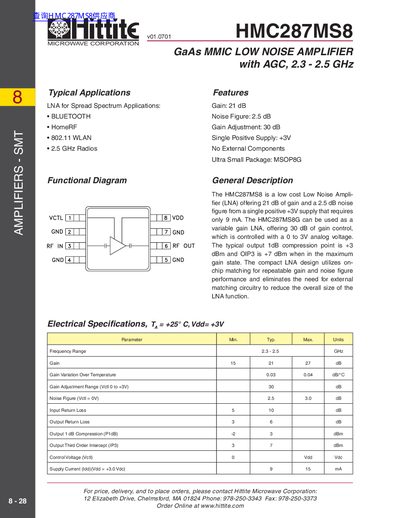
The HMC287MS8 is a low‑cost GaAs MMIC low‑noise amplifier (LNA) that provides 21 dB typical gain and a 2.5 dB noise figure across 2.3‑2.5 GHz. It operates from a single +3 V supply drawing only about 9 mA and includes 30 dB of analog gain control without the need for external matching components.
Typical applications include Bluetooth, HomeRF, 802.11 WLAN and other 2.5 GHz radios. An evaluation PCB with SMA connectors and a Rogers 4350 substrate is available from Hittite for rapid prototyping.
| Frequency Range | 2.3 - 2.5 GHz |
|---|---|
| Gain (typical) | 21 dB |
| Noise Figure (typical) | 2.5 dB |
| Gain Adjustment Range | 30 dB |
| Supply Voltage | +3 V |
| Output 1 dB Compression Point | +3 dBm |
| Output Third‑Order Intercept (OIP3) | +7 dBm |
| Input Return Loss | 5‑10 dB |
| Output Return Loss | 3‑6 dB |
The HMC287MS8 provides a typical gain of 21 dB.
It operates from a single +3 V supply and draws about 9 mA of current.
The amplifier works over 2.3 GHz to 2.5 GHz.
No external components are required; the device uses on‑chip matching.