
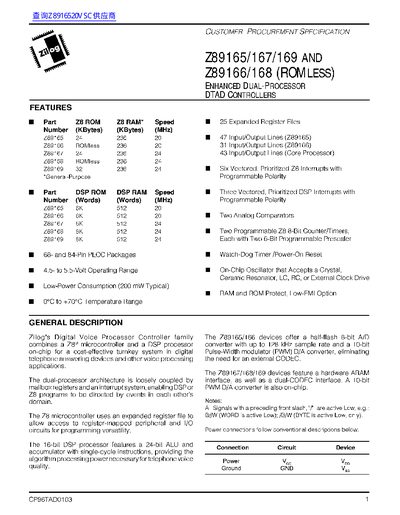
Zilog's Digital Voice Processor Controller family combines a Z8® microcontroller and a DSP processor on‑chip for cost‑effective voice processing in telephone answering devices and similar applications. The dual‑processor architecture uses mailbox registers and an interrupt system to allow Z8 and DSP programs to interact.
The devices offer various memory configurations (e.g., 24 KB ROM, 236 KB RAM for the Z89165), operating voltage of 4.5‑5.5 V, low‑power consumption (200 mW typical), and a temperature range of 0 °C to +70 °C. They provide up to 47 programmable I/O lines, two analog comparators, two 8‑bit counters/timers, and a watchdog timer/power‑on reset. Pin‑out tables and package dimensions are detailed for 68‑ and 84‑pin PLCC packages.
| ROM (Z8) size | 24 KB |
|---|---|
| RAM size | 236 KB |
| Operating voltage range | 4.5‑5.5 V |
| Power consumption (typical) | 200 mW |
| Temperature range | 0 °C to +70 °C |
| I/O lines (Z89165) | 47 |
| Analog comparators | 2 |
| Programmable counters/timers | Two 8‑bit counters |
| Watch‑Dog Timer / Power‑On Reset | Included |
The controllers operate from 4.5 V to 5.5 V.
The Z89165 provides 47 programmable input/output lines.
They are rated for operation between 0 °C and +70 °C.
Typical power consumption is 200 mW.