
This document describes the features and characteristics of the digital transistors DTC123YE / DTC123YUA / DTC123YKA produced by ROHM, including built-in resistors, easy device design, and complete elimination of parasitic effects.
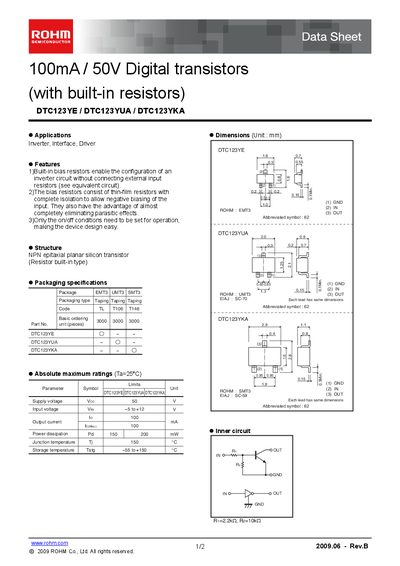
The DTC123YUA is a 100 mA, 50 V digital NPN transistor with built‑in bias resistors, suitable for inverter, interface and driver circuits. Its thin‑film resistors allow negative biasing and minimize parasitic effects, simplifying circuit design.
Key specifications include a 50 V supply rating, -5 to +12 V input range, 100 mA output current, 150‑200 mW power dissipation, 150 °C junction temperature, and a typical DC current gain of 33. The device is offered in EMT3, UMT3 and SMT3 tape packages.
| Supply voltage (VCC) | 50 V |
|---|---|
| Input voltage range | -5 to +12 V |
| Output current (max) | 100 mA |
| Power dissipation (PD) | 150‑200 mW |
| Junction temperature (TJ) | 150 °C |
| Storage temperature (TSTG) | -55 to +150 °C |
| Transition frequency (fT) | 250 MHz |
| DC current gain (hFE) | 33 |
| Input resistance (Ri) | 2.2 kΩ (typ) |
| Resistance ratio (Re/Ri) | 3.6 (typ) |
They are intended for inverter, interface and driver circuits.
The device can be powered up to 50 V.
It is offered in EMT3, UMT3 and SMT3 tape packages.
The typical DC current gain is 33.