
This document describes the features and characteristics of the DTC144V series digital transistors produced by ROHM. The transistors in this series have built-in bias resistors, which allow the configuration of an inverter circuit without connecting external input resistors. The bias resistors consist of thin-film resistors with complete isolation to enable negative biasing of the input and eliminate parasitic effects. Only the on/off conditions need to be set for operation, making the circuit design easy. The series also includes complementary PNP types, the DTA144V series.
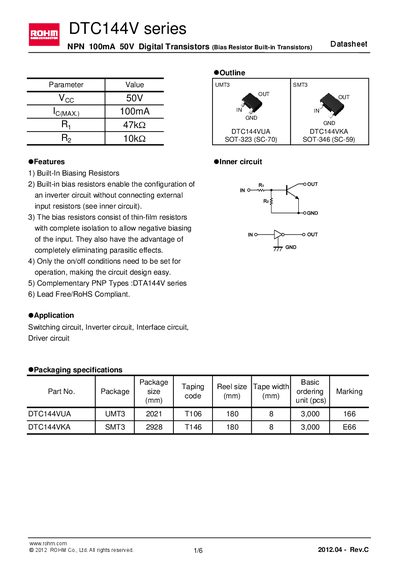
The DTC144VKA is a NPN digital transistor with a built‑in bias resistor, designed for switching, inverter, interface and driver circuits. It offers a compact SOT‑323 (UMT3) or SOT‑346 (SMT3) package and complies with RoHS standards.
Key specifications include a 50 V supply rating, 100 mA collector current, 200 mW power dissipation, and a transition frequency of up to 250 MHz. The datasheet also lists detailed electrical characteristics, absolute maximum ratings, and mechanical dimensions for both package types.
| Supply voltage (Voc) | 50 V |
|---|---|
| Collector current (I_C max) | 100 mA |
| Power dissipation (P_D) | 200 mW |
| Junction temperature (Tj) | 150 °C |
| Storage temperature range | -55 °C to +150 °C |
| Input resistance (R_in) | 47 kΩ |
| Transition frequency (f_T) | 250 MHz |
| Package types | SOT‑323 (UMT3) and SOT‑346 (SMT3) |
The maximum supply voltage is 50 V.
The device can handle up to 100 mA of collector current.
It is offered in SOT‑323 (UMT3) and SOT‑346 (SMT3) packages.
The transition frequency is specified up to 250 MHz.