
This document is about the specifications of DTC144WE/DTC144WUA/DTC144WKA digital transistors, introducing the features and characteristics of the products.
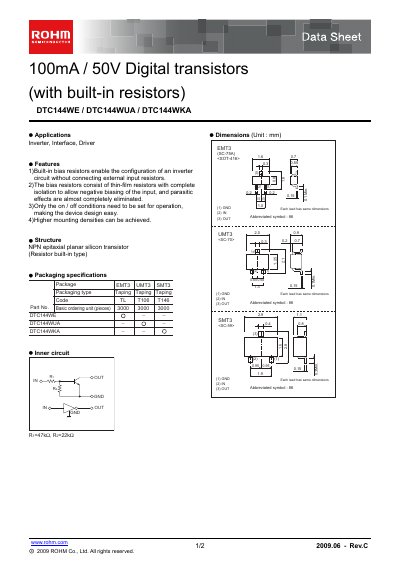
The DTC144WE, DTC144WUA and DTC144WKA are 100 mA / 50 V NPN digital transistors with built‑in thin‑film bias resistors. The built‑in resistors simplify inverter circuit design by eliminating the need for external input resistors and allow negative biasing with minimal parasitic effects.
The datasheet provides detailed package dimensions (EMT3, UMT3, SMT3), absolute maximum ratings, and electrical characteristics such as supply voltage, input/output voltage ranges, current gain, and transition frequency. Application notes mention typical uses in inverters, interfaces and drivers for general‑purpose electronic equipment.
| Supply voltage (Veco) | 50 V |
|---|---|
| Input voltage range | -10 to +40 V |
| Output current (max) | 30 mA |
| Power dissipation | 150 mW (DTC144WE) |
| Junction temperature (Tj) | 150 °C |
| Storage temperature | -55 to +150 °C |
| Transition frequency (fT) | 250 MHz |
| Package types | EMT3, UMT3, SMT3 |
The maximum supply voltage (Veco) is 50 V.
They are offered in EMT3, UMT3 and SMT3 surface‑mount packages.
The transition frequency is specified as 250 MHz.
Yes, the bias resistors are thin‑film resistors with complete isolation, allowing negative biasing and minimizing parasitic effects.