
DTA144E series PNP -100mA -50V Digital Transistors (Bias Resistor Built-in Transistors) feature built-in bias resistors (R1 = R2 = 47kW) that enable the configuration of an inverter circuit without connecting external input resistors (see inner circuit). The bias resistors consist of thin-film resistors with complete isolation to allow negative biasing of the input. They also have the advantage of completely eliminating parasitic effects. Only the on/off conditions need to be set for operation, making the circuit design easy.
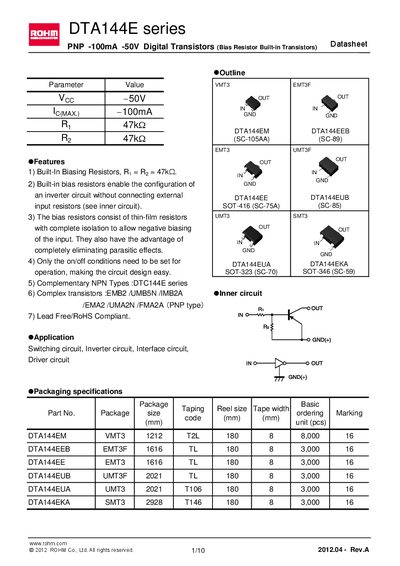
The DTA144E series are PNP digital transistors featuring built‑in 47 kΩ bias resistors, allowing inverter circuits without external resistors. They are RoHS‑compliant and offered in several surface‑mount packages such as SOT‑416, SOT‑323 and SOT‑346.
The datasheet lists absolute maximum ratings, electrical characteristics, dimensional drawings for each package, and typical application circuits like switching, inverter, interface and driver circuits. It also includes packaging and ordering information for each variant (e.g., DTA144EUB).
| Supply voltage (VEO) | -50 V |
|---|---|
| Input voltage (VIN) | -40 V to +10 V |
| Output current (IO) | -30 mA |
| Collector current max (ICmax) | -100 mA |
| Built‑in bias resistor value | 47 kΩ |
| Transition frequency (fT) | 100 MHz – 250 MHz |
| Junction temperature (Tj) | 150 °C |
The maximum supply voltage is -50 V.
Each built‑in bias resistor is 47 kΩ.
The transition frequency ranges from 100 MHz to 250 MHz.