
This document describes the features and characteristics of ROHM's DTA124GKA digital transistor, including built-in resistors, easy device design, and high mounting densities. It is suitable for applications such as inverters, interfaces, and drivers.
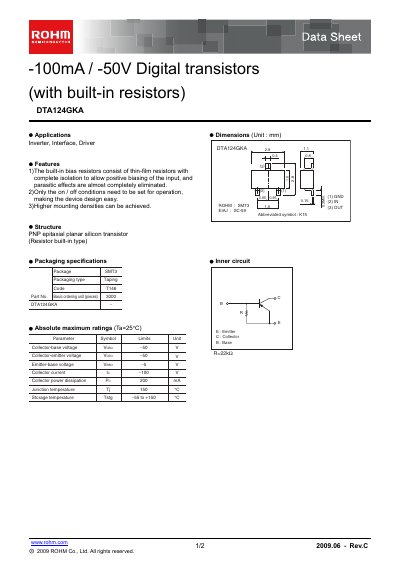
The DTA124GKA is a PNP epitaxial planar silicon digital transistor with built‑in thin‑film bias resistors, designed for inverter, interface and driver applications. The device offers complete isolation for positive input biasing and simplifies circuit design.
Key specifications include a collector‑base voltage of -50 V, collector‑emitter voltage of -50 V, emitter‑base voltage of -5 V, and a maximum collector current of 100 mA. The part is supplied in an SMT3 tape package with a basic ordering unit of 3000 pieces.
| Collector‑base voltage (Vcbo) | -50 V |
|---|---|
| Collector‑emitter voltage (Vceo) | -50 V |
| Emitter‑base voltage (Veso) | -5 V |
| Collector current (Ic) | 100 mA |
| Junction temperature (Tj) | 150 °C |
| Package type | SMT3 tape |
| Packaging type | Taping |
The device can handle up to 100 mA of collector current.
It is suitable for inverter, interface, and driver circuits.
The transistor is supplied in an SMT3 tape package.
Collector‑base and collector‑emitter voltages are rated at -50 V, and emitter‑base at -5 V.