
The document describes the principle of infrared sensors and the structure and performance characteristics of infrared emitters based on GaAs material. GaAs infrared chips have high luminous efficiency, emit wavelengths between 940 and 950 nanometers, and have a response time of approximately 1 microsecond.
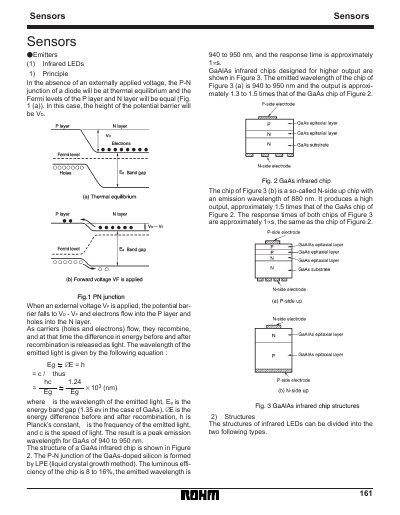
The handbook provides an overview of infrared LED sensors, covering the physical principles of P‑N junction operation, emission wavelengths, luminous efficiency, response time, and chip structures. It details both GaAs and GaAlAs infrared chips, including the higher‑output N‑side‑up variant.
Additional sections describe various sensor types such as phototransistors, photo ICs, photointerrupters, and photoreflectors, along with packaging options and application notes. The appendix contains usage warnings and copyright information.
| GaAs emission wavelength | 940–950 nm |
|---|---|
| N‑side up chip emission wavelength | 880 nm |
| Luminous efficiency | 8–16 % |
| Response time | ~1 µs |
| Output power (GaAlAs vs GaAs) | 1.3–1.5× higher |
The GaAs infrared LED emits light in the 940 to 950 nm wavelength range.
Both GaAs and GaAlAs infrared LEDs have a response time of about 1 µs.
The chips are available in two packaging types: cast type and molded type.
The GaAlAs chip provides roughly 1.3 to 1.5 times higher output power than the GaAs chip.