
S2S5 Series Phototriac Coupler is a non-zero cross type, and can be used to trigger triacs to switch on and off AC loads, such as heaters, fans, motors, solenoids and valves. It can also be used to implement phase control in applications such as lighting control and temperature control (HVAC), and for AC line control in power supply applications.
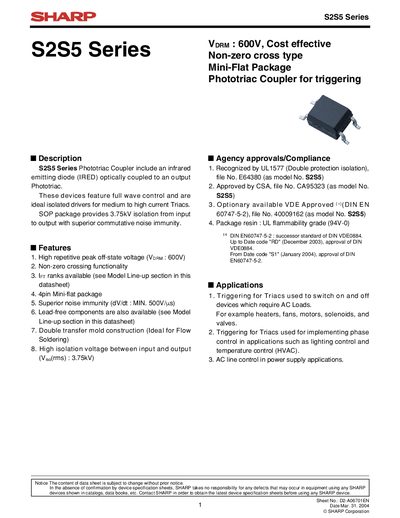
The Sharp S285 Series phototriac coupler integrates an infrared emitting diode (IRED) optically coupled to a phototriac, offering full‑wave control for medium to high current triacs. The device is supplied in a 4‑pin Mini‑flat SOP package with 3.75 kV isolation and superior dV/dt immunity.
The datasheet lists absolute maximum ratings, electro‑optical characteristics, and design considerations, including recommended snubber circuits, degradation expectations, and packaging options such as tape‑and‑reel (3 000 pcs/reel). Application examples cover AC load switching, phase‑control lighting, HVAC, and power‑supply control.
| Input forward current (I_F) | 50 mA |
|---|---|
| Reverse voltage (V_R) | 6 V |
| RMS ON‑state current (I_RMS) | 0.05 A |
| Peak one‑cycle surge current (I_surge) | 0.6 A |
| Operating temperature range | -30 °C to +100 °C |
| Storage temperature range | -40 °C to +125 °C |
| Maximum dV/dt rating | ≥ 500 V/µs |
The device can tolerate a reverse voltage of up to 6 V.
The coupler operates from –30 °C to +100 °C.