
The document describes the features and characteristics of the SLD324ZT high-power density 2W laser diode, including high power output, low operating current, and newly developed flat package.
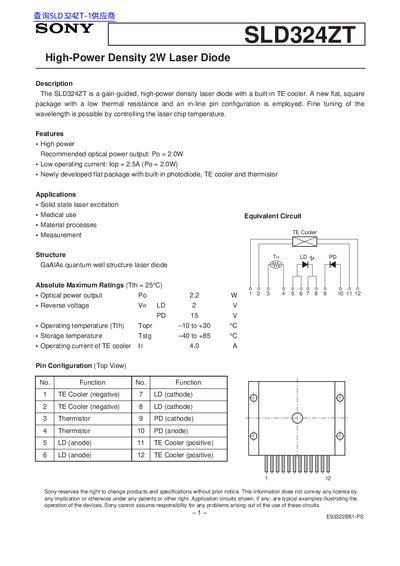
The Sony SLD324ZT is a gain‑guided, high‑power density laser diode with a built‑in TE cooler and a flat square package. It delivers up to 2 W of optical output while operating at a low current of about 2.5 A.
The datasheet lists absolute maximum ratings, pin assignments, electrical and optical parameters, and safety guidelines such as mandatory eye protection and infrared‑blocking goggles. Graphs illustrate power, wavelength, and efficiency variations with temperature and current.
| Recommended optical power output | 2.0 W |
|---|---|
| Operating current (low) | 2.5 A |
| Threshold current (Ith) | 0.6 A – 1.0 A |
| Reverse voltage (V_R) | 2 V |
The recommended optical power output is 2.0 W.
Eye protection is required; always use safety goggles that block infrared rays, and IR scopes or cameras are recommended for monitoring.
The top‑view pin configuration includes TE cooler (negative) on pins 1‑2, thermistor on pins 3‑4, laser diode (anode) on pins 5‑6, photodiode (anode) on pin 10, and TE cooler (positive) on pins 11‑12.